
What the Study Found
- Researchers formally described Colobus congoensis, or Likweli, only the fifth new African monkey species named in 75 years.
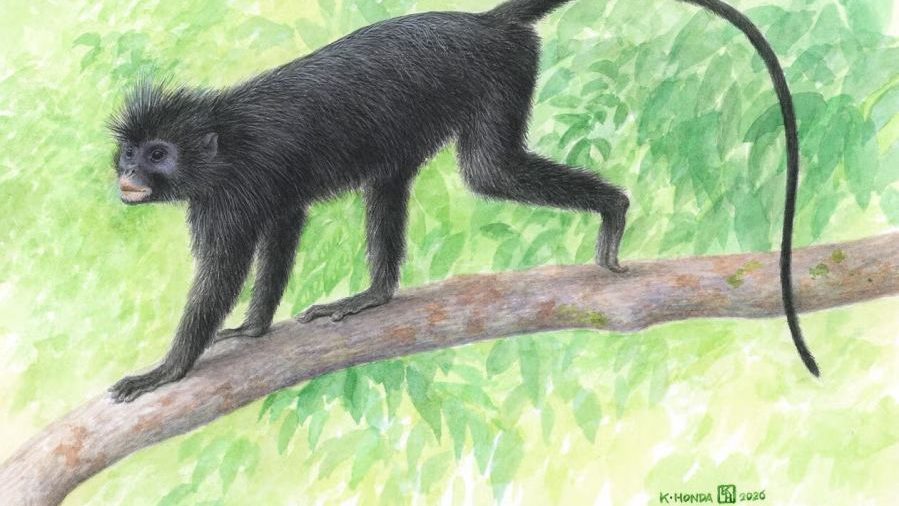
- The all-black monkey has a striking orange-cream mouth patch and a white perianal patch, and is genetically sister to the distant black colobus.
- It occupies just 1,700 km² of clay-soil forest in DRC’s Lomami interfluve, over 1,200 km from its closest relative.
- Authors propose an Endangered listing, citing the tiny range plus looming hunting and habitat-loss pressures.
In August 2018, a park patrol in the Democratic Republic of Congo photographed a small black monkey with an odd cream smudge around its mouth, wrote it down as something ordinary, and moved on. Nobody flagged it. The image sat in a survey report for the better part of a year, misfiled, while the animal it showed remained unknown to science. Only later, cross-checking earlier photos, did the researchers realise the patrol had captured one of the rarest primates on the continent and walked right past it.
That animal now has a name: Colobus congoensis, or Likweli, described this week in the journal PLOS One. It is only the fifth new species of African monkey found in three quarters of a century, and it lives at the top of some of the densest forest canopy in the Congo Basin.
Getting a clean look at it was the whole problem. The monkey keeps to the high, closed canopy of Lomami National Park, an 8,874-square-kilometre reserve threaded between three tributaries of the Congo. It travels in small groups, often mixed in with other monkey species, and it is quiet. The team logged 114 sightings across four years over a range of roughly 1,700 square kilometres, and even that took an enormous amount of walking: thousands of kilometres of reconnaissance through trackless forest, much of it on the strength of local field leaders who knew when something in the trees didn’t fit.

“The discovery and documentation of the Likweli never would have happened without our team of Congolese explorer naturalists,” said John Hart of the Lukuru Wildlife Research Foundation, the study’s lead author. It was their attentiveness, he added, that produced some of the most telling evidence for the find.

Ten Years to Be Sure
The first hint came back in 2008, when explorers photographed an unfamiliar monkey high on the east bank of the Lomami River. The picture showed only part of the animal. Suspicious, yes, but nowhere near enough. Then nothing, for a decade, until a patrol led by Jean Pierre Kapale in November 2018 photographed a black monkey with pale markings round its mouth and a white patch beneath its tail, unlike anything known from the area. Over the next ten months Kapale and his team found it seven more times.
“Only after 10 years of exploring the Lomami Forest did we have enough clear views and convincing photos to allow us to say that there was yet another new monkey,” said Terese Hart, also of the Lukuru foundation. The primate was not just new, she noted; it was extremely rare, with a strikingly limited range.
What clinched it was the way three separate lines of evidence pointed the same direction. The monkey is small, with an almost entirely black coat, a mask of bare dark skin, and that piebald orange-cream patch around the mouth and nose that no other black colobus wears. Its teeth and skull differ from those of its nearest relative. Its roars (recorded on everything from a shotgun microphone to somebody’s mobile phone) share the rapid pulse and high pitch of that relative but break the sequence differently, with a distinctive snort tucked between calls. And the genetics placed it firmly on its own branch. “Our team evaluated multiple datasets that all reached the same conclusion: Likweli is a distinct species of Colobus monkey we haven’t seen before,” said Julia Arenson, a postdoctoral fellow at Yale and a coauthor. Discovering any primate species, she added, is exceptionally rare, let alone one from a population nobody had documented.
A Relative 1,200 Kilometres Away
Here’s the strange part. Likweli’s closest cousin, the black colobus C. satanas, lives more than 1,200 km to the west, in the forests of Gabon and on an island in the Gulf of Guinea. The two split, by the team’s molecular clock, somewhere around 4 to 5 million years ago: the deepest divergence anywhere in the colobus family tree, older than the gap between any other pair of these monkeys. Which raises a question the paper can’t fully answer: How did a lineage end up marooned in a small pocket of central Congo, hemmed in by rivers, while its sister thrived a continent’s width away?
The rivers may be the key. The Lomami on one side is broad enough to stop an arboreal monkey cold. On the other, narrower streams have carved out pockets of nutrient-poor white-sand forest, the sort of low-quality habitat that this canopy specialist seems unwilling or unable to cross. Boxed in, in other words, by geography and by fussiness about where it will live.
None of which bodes well for its future. The researchers propose listing Likweli as endangered, and the math is not reassuring: a small population, a tiny range, and a human population in the DRC growing at more than 3 per cent a year, with forest in the surrounding province falling by roughly 4 per cent annually. At least fifteen new villages have appeared in and around its range in less than a decade. “This is a rare discovery with significant conservation implications,” said Eric Sargis, a curator at the Yale Peabody Museum, where the specimens now reside. The analyses, he said, point to a distinct new species that is already endangered.
- Study type: Taxonomic species description integrating morphological, genetic, and bioacoustic evidence with multi-year field surveys; peer-reviewed (PLOS One, 2026)
- Data sources: 114 field detections (2018–2022) over ~1,700 km²; 3 voucher specimens (1 male, 2 females); mitochondrial DNA (4,090 bp) from 3 individuals; 3 roar recordings suitable for acoustic analysis; local-knowledge interviews across 52 villages
- Comparative sample: 182 skeletal specimens spanning 13 African colobine species; roar comparisons against C. satanasand five other Colobus species
- Key finding: Sister species to C. satanas, from which it is separated by more than 1,200 km; divergence estimated at roughly 4.1–5.0 million years ago (Pliocene)
- Geographic scope: Lomami–Lualaba interfluve, Tshopo and Maniema provinces, DR Congo; range mostly within Lomami National Park
- Funding / conflicts of interest: Supported by National Geographic Society, US Fish and Wildlife Service, Frankfurt Zoological Society, National Science Foundation, Leakey Foundation, and others; no competing interests declared
- Conservation status: Authors propose provisional IUCN Red List classification of Endangered (EN)
- Main limitation: Very small specimen and genetic sample (3 individuals; mtDNA only), which constrains statistical power and divergence-date precision; nuclear genome data would refine phylogeny and timing
Reference
Hart, J. A., Amboko, J. D., Arenson, J. L., Horton, E. R., Coates, K. F., Kapale, J.-P. I., Koko, M. B., Hart, T. B., Gilbert, C. C., Sargis, E. J., & Detwiler, K. M. (2026). Likweli: A remarkable new species of Colobus monkey from the Lomami National Park, Democratic Republic of Congo. PLOS One, 21(7), e0349857. https://doi.org/10.1371/journal.pone.0349857
Frequently Asked Questions
Why does finding a new monkey species matter so much?
Finding a new monkey species matters so much because it is rare: Likweli is only the fifth new species of African monkey identified in the past 75 years. Each such discovery reveals a gap in what we know about a region’s biodiversity and, in this case, flags an animal that is already endangered and in need of protection.
How can a monkey stay hidden from science until 2026?
A monkey can stay hidden from science until 2026 by living high in dense, closed forest canopy, keeping to small quiet groups, and occupying a range of only about 1,700 square kilometres in a remote part of the Congo. Likweli was so cryptic that residents in only eight of 52 nearby villages even recognised it, and one early patrol photo was misidentified and overlooked for months.
What makes Likweli different from other black colobus monkeys?
What makes Likweli different from other black colobus monkeys is a combination of features no other member of the group shares: a small body, a striking orange-cream patch of bare skin around the mouth and nose on an otherwise black face, a white patch beneath the tail, distinctive teeth, and roars that carry a signature snort. Genetic analysis also places it on its own deep branch, splitting from its nearest relative around 4 to 5 million years ago.
Why does Likweli’s closest relative live so far away?
Likweli’s closest relative lives so far away, more than 1,200 kilometres to the west, because the two lineages split millions of years ago and Likweli became boxed into a small range by natural barriers. Wide rivers and belts of nutrient-poor white-sand forest appear to fence the species in, leaving it as a likely relict of a once broader group.
Is Likweli in danger of disappearing?
Likweli is in danger of disappearing, which is why researchers recommend classifying it as endangered. Its tiny range and small population sit within a region facing rapid human population growth, expanding settlements, and forest loss of roughly 4 per cent a year, making protection of Lomami National Park the single most important step for its survival.


Cite This Page