
What the Study Found
- Removing a constraint once treated as essential still reached a workable route in nearly every one of 1,000 simulated trials at each city count.
- The updated model handled route-planning problems with up to 180 cities, six times the roughly 30-city practical limit of the original version.
- It cut the computational steps needed to reach a solution by one to two orders of magnitude compared with the earlier model.
- The model’s dynamics turn out to be mathematically equivalent to a small recurrent neural network with fixed, untrained weights.
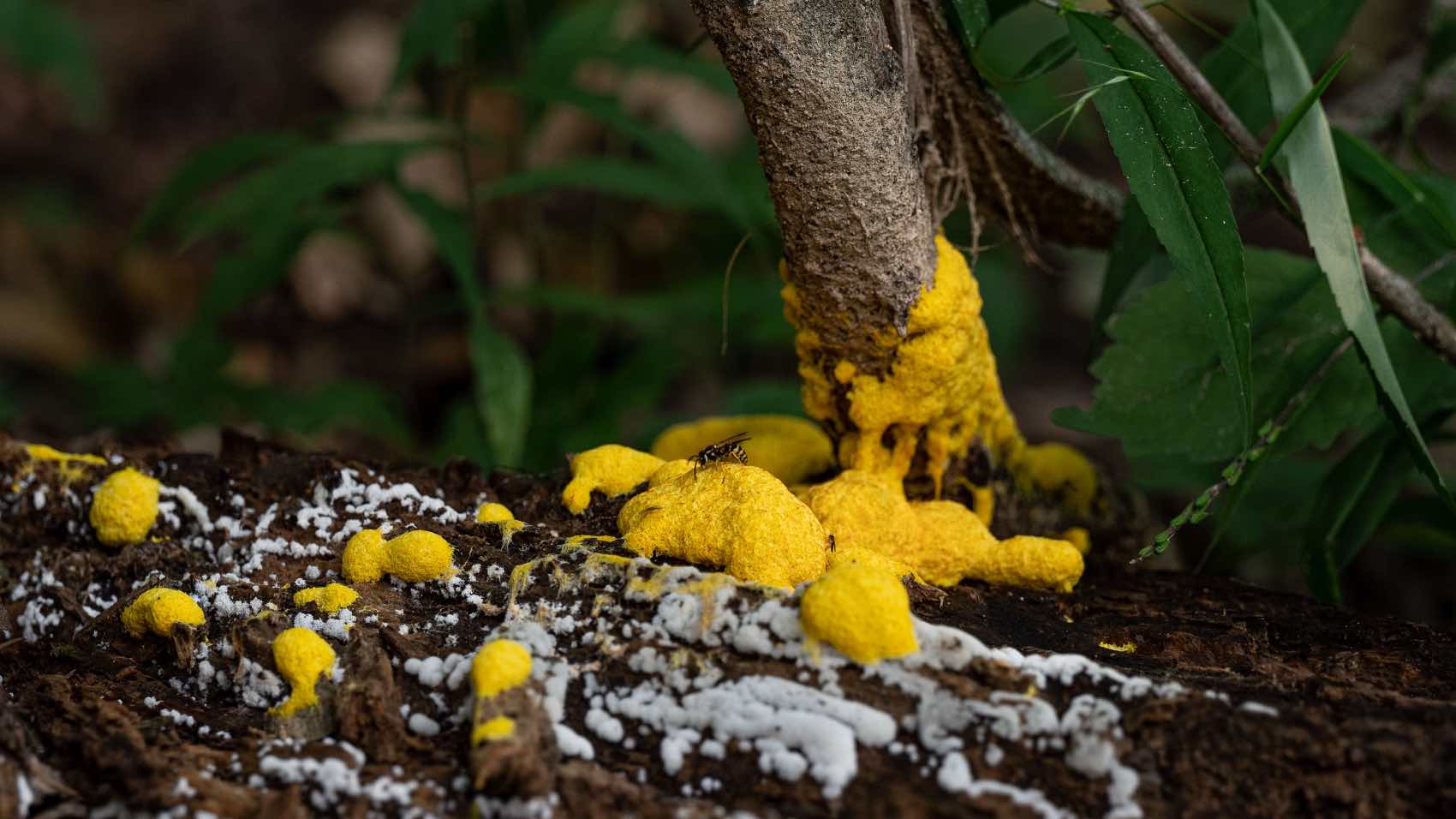
Drop an amoeba into a small circular dish with narrow lanes radiating out from the center, like spokes on a wheel, and it does something useful without knowing it. It creeps into whichever lanes stay dark, hunting nutrients, and pulls back from whichever ones light up. A new mathematical model shows that ditching a rule long assumed essential to that process, the idea that the creature’s total volume has to stay constant as it stretches and retracts, does not hobble the search. It speeds it up, and lets the same approach handle roughly six times as many cities.
Slime molds have no brain, no neurons, and yet they can approximate solutions to hard optimization problems just by deforming, a talent researchers first demonstrated when a maze-solving Physarum polycephalum found the shortest route between two food sources back in 2000. Researchers have kept extending that finding since: as recently as 2025 a team was still coaxing a living Physarum through eight-city routing problems in the lab, tracking which internal rhythms mark out its best solutions.
The specific puzzle in question is the traveling salesman problem (TSP): given a set of cities, find the shortest route that visits each one once and returns home. The Amoeba TSP model represents each candidate route as a set of illuminated and dark lanes, with the amoeba’s branch lengths in each lane standing in for a tentative solution. For years, the model assumed the total length of all the branches together had to stay fixed, mirroring the volume-conservation law of a real organism’s body. That constraint was treated as load-bearing, the thing that gave the search its power.

It turned out not to be. Earlier work by the same Waseda University team had already shown the conservation rule could be dropped without hurting performance. What remained unsolved was how to turn that insight into a model simple enough to build.
Yusuke Miyajima and Masahito Mochizuki, both at Waseda’s Department of Applied Physics, went further. They stripped out the conservation constraint entirely, replaced several sigmoid functions with plain constants or step functions, and removed a counting operation and a set of conditional branches that a physical device would have struggled to reproduce. The result is a single recurrence formula: one equation, applied over and over, with no branching logic to wire up. Gone too is the assumption that the random fluctuation driving each branch’s wobble has to come from a uniform distribution; the new model draws it from a Gaussian one instead, the kind of noise that ordinary thermal jitter already produces for free.
“Our approach eliminates a major constraint, the volume-conservation law, making it possible to implement slime-mold computers using a much wider variety of materials and physical phenomena,” explains Miyajima.

Assistant Professor Yusuke Miyajima and Professor Masahito Mochizuki from Waseda University
Fewer Rules, Bigger Maps
Run 1,000 simulated routing problems through the new model at each city count, and the pattern holds up. Every single trial from 20 cities to 170 cities reached a workable route, and the model reduced the number of computational steps needed by one to two orders of magnitude compared with the original Amoeba TSP model. At 20 cities it averaged 70.8 iterations to find a solution; at 170 cities, 446.2. Route quality held roughly steady too, landing at 0.916 of the theoretical average shortest length at 20 cities and 0.827 at 130 cities, on par with or better than its predecessors. Where the original Amoeba TSP model topped out at around 30 cities in practice and an earlier refinement reached about 100, the new formula scaled to 180, a problem size that would have taken the old approach far too long to simulate.
Not every run succeeded. In one of 1,000 simulated attempts at the largest test size, a 180-city map generated from a particular random distribution, the model failed to reach a feasible route inside its iteration limit. And the researchers are candid that they do not yet fully understand how one of the model’s tuning knobs, a parameter controlling how far a branch reaches into an unlit lane, shapes performance; working that out is left for later study.
Nothing here has been built as a physical device yet. Earlier amoeba-inspired route-planning circuits have made it into hardware before, including an analog electronic version built at Hokkaido University, but those relied on the older, more constrained model. The paper’s own data statement notes that no public dataset or code accompanies this work, and the proposed hardware, a design built from magnetic domain walls in a thin ferromagnetic film, exists on paper for now: a promising blueprint rather than a working machine.
A Second Life as a Neural Network
The most striking result may be a side effect. Working through the simplified equation, Miyajima and Mochizuki showed it is mathematically equivalent to a small recurrent neural network with fixed connection weights, the kind of network where nothing is trained; the weights simply encode the distances between cities and the penalties for breaking the rules of the route. That equivalence means hardware already being developed for neural network chips, memristor arrays, photonic circuits, and the ferromagnetic domain-wall devices the team sketches out, could in principle run this slime-mold-derived search without much modification; researchers elsewhere have already shown that a single magnetic domain wall can do the kind of fixed-weight network computing this equivalence calls for. “The increased flexibility of our model can accelerate the development of energy-efficient slime-mold computers,” says Mochizuki. “This decentralized mode of information processing could prove valuable for AI and large-scale combinatorial optimization, where conventional computers require significant power consumption.”
The connection cuts in both directions. If a formula this simple, born from watching a single-celled organism avoid light, turns out to share its bones with a recurrent neural network, it raises the possibility that the two forms of computation are not so far apart. A cell finding its way to nutrients and a network finding its way to a low-energy state may be running variations on the same underlying trick.
Reference
Miyajima, Y., & Mochizuki, M. (2026). Mathematical model of the amoeba-inspired combinatorial optimization machine for physical implementation and its equivalence to recurrent neural networks. Physical Review Research, 8(2). https://doi.org/10.1103/zgvb-cfpg
- Study type: Peer-reviewed computational modeling study, evaluated by numerical simulation (Physical Review Research).
- Sample size: 1,000 simulated trials per city count for the proposed model, 500 for the original model cited for comparison; cities ranged from 20 to 180.
- Model: A single recurrence formula derived by simplifying the existing Amoeba TSP model, removing its volume-conservation constraint, conditional branching and a counting step.
- Inputs and assumptions: Synthetic traveling salesman problem maps with inter-city distances drawn from a normal distribution (mean 100, standard deviation 17).
- Funding / conflicts of interest: Waseda University research grants, a JSPS KAKENHI grant, and a CREST/JST grant; no conflicts of interest declared.
- Data availability: Not reported; the paper states no public dataset or code accompanies it and directs requests to the authors.
- Main limitation: Performance is demonstrated entirely in simulation on synthetic maps; no physical device has been built, and one tuning parameter’s effect on performance is not yet understood.
FAQ
Why did the volume-conservation law seem necessary in the first place?
The rule mirrored something real: a living amoeba’s body genuinely does conserve its own volume as it stretches into some lanes and pulls back from others, so early versions of the model built that constraint in to stay faithful to the organism. It turned out to be a faithful detail rather than the source of the computing power.
Could this actually get built into a real chip or device?
Building this into a real chip or device is still an open question, but the paper argues yes in principle. The recurrence formula is simple enough that the researchers sketch a design using magnetic domain walls in a thin ferromagnetic film, and note that photonic circuits and memristor arrays are also candidates, though none of these has been built yet.
Is this the same as training a neural network?
No. The recurrent neural network the model turns out to match has fixed connection weights that encode city distances and routing penalties directly, rather than weights learned from training data, so nothing here is trained in the usual machine-learning sense.
What actually limits how many cities the model can handle?
What limits the model is less a hard mathematical ceiling than computation time: the researchers tested up to 180 cities and it kept finding workable routes almost every time, but they stopped there rather than hitting a wall, so larger problems remain untested.
Does dropping the conservation law make the model less biologically realistic?
Somewhat, yes, and the researchers do not claim otherwise; the point of the paper is that fidelity to the amoeba’s literal physics was getting in the way of building a useful device, not that the constraint was never real.


Cite This Page