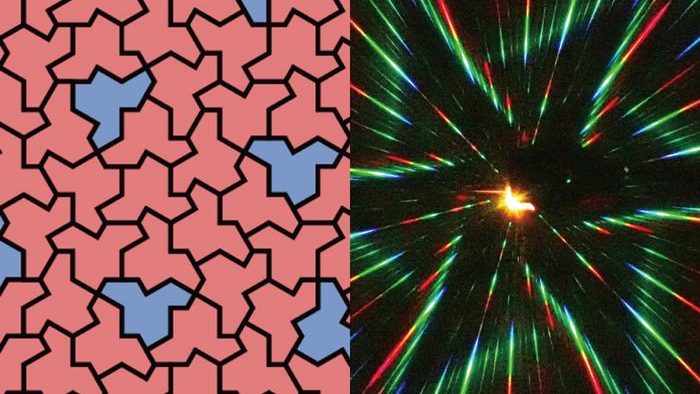
A 13-sided shape that a retired print technician cut out of card in 2022 settled a question mathematicians had been chewing on for 60 years. Four years on, physicists keep finding new behavior in it, and this unique shape is now often referred to as the smith hat.
The problem the Smith hat solved
A bathroom wall tiled in squares repeats. Slide the whole wall sideways by one tile and nothing looks any different. Mathematicians call that periodicity, and most tilings have it: triangles, squares and hexagons all fill a flat surface in patterns that go on repeating forever.
The question, asked and re-asked from the early 1960s on, was whether a single shape could cover a surface without ever repeating. Roger Penrose got close in the 1970s with a pair of shapes, a fat rhombus and a thin one, that tile the plane in patterns that never repeat while showing a clear five-fold symmetry. Two shapes, though, not one. Nobody could find a tile that managed the trick alone, and the puzzle picked up a nickname: the einstein problem, from the German ein Stein, one stone. (Nothing to do with Albert Einstein, though the pun has probably sold the problem to more people than the mathematics ever did.)

The answer came from outside academia, in November 2022. David Smith, a retired print technician in Yorkshire who cuts out shapes for the pleasure of it, was working through polyforms to see what patterns they made when one of them refused to settle into a repeat. He could not tell whether it truly never repeated, that is not the sovrt of thing you can settle by looking. So he wrote to Craig Kaplan at the University of Waterloo, who ran the shape through software he had written himself; Kaplan brought in Joseph Myers and Chaim Goodman-Strauss, and in March 2023 the four of them published a proof.
Eight kites glued together
Thirteen sides, and a passing resemblance to a fedora. Hence “hat”. Turn it around and it looks more like a T-shirt, which tells you roughly how much the name is worth.
Its construction is tidier than the outline suggests. Cut each hexagon of a honeycomb into six kites by joining the midpoints of opposite edges, and the hat is simply eight of those kites, taken from three neighboring hexagons and glued together. Researchers tend to call it a polykite for that reason.
The hat is one of a family. Change the relative lengths of its edges and other tiles in the same family work too. The standard version is written Tile(1, √3); a relative with 10 kites, Tile(√3, 1), behaves in much the same way.
One detail keeps mathematicians honest about the claim: a hat tiling needs both the tile and its mirror image, sometimes called the anti-hat. That left an obvious follow-up question, and the same four researchers answered it two months later with a curved-edged shape called the spectre, which tiles with no reflected copies at all.
Why physicists took an interest
A tiling is not only a picture. It’s also a template for where to put atoms, holes or spins in a real material. Non-repeating structures have been fair game in physics since 1984, when Dan Shechtman found metal alloys showing a five-fold symmetry that no repeating crystal can have. Those materials became known as quasicrystals; Shechtman took the 2011 Nobel Prize in Chemistry for them.
The hat is not quite a quasicrystal, though. When mathematicians worked out its underlying structure, they found that its vertices form a two-dimensional quasiperiodic lattice, but one from a class with a fractal boundary (rather than the neat polygonal boundary a Penrose tiling has). That difference is the reason to look: it suggests the hat might behave in ways quasicrystals do not.
Two lines of work have tested the idea so far.
Yutaka Okabe at Tokyo Metropolitan University and colleagues ran the Ising model on the hat lattice in 2024. The Ising model is the standard workhorse for magnetism, each site holding a spin that points either up or down. Using Monte Carlo simulations of up to 939,201 spins, the team put a number on the temperature at which the material flips from ordered to disordered, and confirmed that a classical relationship between a lattice and its dual, first described in 1941, still holds on an aperiodic lattice. The critical temperatures landed close to those of the Penrose lattice and to two ordinary repeating lattices with the same average number of neighbors. Not a dramatic answer, but a reassuring one.
The optical result is newer. In July 2026, a team led by Yuto Moritake and Masaya Notomi at the Institute of Industrial Science, the University of Tokyo, reported in Nature Communications what laser light does when it meets a hat pattern. They etched the pattern into silicon nitride films using electron-beam lithography, then shone light through it.
Because the hat has no mirror symmetry, the diffraction pattern it produced was chiral, forming pinwheel shapes. The pattern also shifted with the direction and polarization of the incoming light, and structures built as mirror images produced reversed optical behavior. Conventional quasicrystals do nothing of the sort.
The team reckons the effect could be useful for controlling polarization and steering light in optical devices. Which would be a strange career for a shape that started life as a hobbyist’s cut-out.


Cite This Page