Spin glass is a disordered magnetic state that has quietly shaped neural-network theory, optimization algorithms, and a Nobel Prize. Here is what the physics actually says, and where it’s headed.
Table of Contents
In a Nutshell
- A spin glass is a magnetic material whose atomic “spins” freeze into a random, disordered pattern at a specific freezing temperature, instead of lining up like a normal magnet’s do.
- Giorgio Parisi won half of the 2021 Nobel Prize in Physics [1] for a 1979–80 mathematical solution to spin glass behavior that took roughly 25 years for other mathematicians to fully prove correct.
- Mathematician Michel Talagrand completed that rigorous proof and won the 2024 Abel Prize [2], mathematics’ top honor, largely on the strength of it.
- The same mathematics used to describe frustrated magnets also describes the Hopfield neural network, work that won John Hopfield a share of the 2024 Nobel Prize in Physics [3].
- Classic spin glass alloys like copper mixed with about 1 to 10 atom percent manganese freeze at temperatures as low as roughly 30 kelvin (about -240°C) [4], so the effect itself has no everyday application, even though its mathematics does.
Spin glass is a state of matter in which the tiny magnetic moments of atoms, called spins, get locked into a random, unchanging pattern instead of aligning uniformly the way they do in an ordinary magnet.
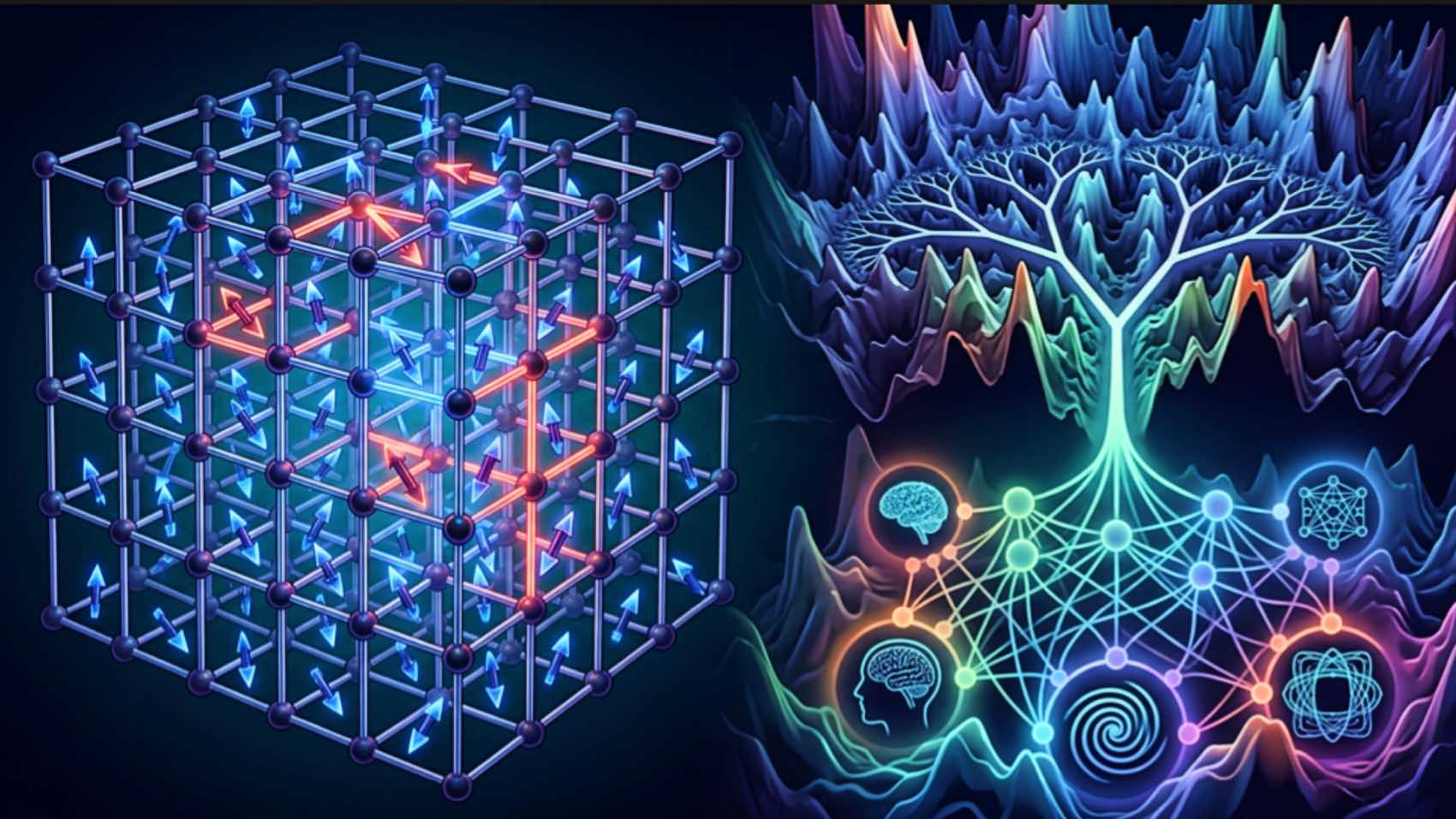
The randomness isn’t a flaw in the material; it’s the defining feature. Below a specific “freezing temperature,” the spins stop fluctuating and freeze into whichever disordered arrangement best resolves the conflicting pulls from their neighbors, a condition physicists call frustration. That single idea, frustration acting on randomly arranged interactions, turned out to be a mathematical template that extends far past magnetism, into how brains and artificial neural networks store memories, how hard optimization problems get solved, and how computer scientists think about error-correcting codes.

What actually makes a magnet a “glass”?
In an ordinary ferromagnet, like the material in a refrigerator magnet, every atomic spin points the same way as its neighbors, minimizing the system’s energy in one clean, uniform pattern. A spin glass starts from the same kind of atomic magnets but wires them together with a mix of interactions: some neighboring spins are pulled to align (ferromagnetic bonds) and others are pulled to point oppositely (antiferromagnetic bonds), and which is which is fixed at random when the material is made. Physicists call this fixed, unchanging randomness “quenched disorder.”
Randomness alone wouldn’t be so interesting. What makes it consequential is frustration: on a simple loop of three or four spins, it becomes mathematically impossible to satisfy every bond’s preference at once. Some connections are always left in the less-favorable, “wrong” orientation. Multiply that across billions of atoms and there’s no longer a single lowest-energy configuration to settle into; instead there’s a vast, rugged landscape of nearly equally good arrangements separated by high energy barriers, and the system gets stuck in one of them rather than finding the true global optimum. The simplest working model, called the Edwards–Anderson model [5], places spins on a grid and only lets each one interact with its immediate neighbors, with the sign of each connection drawn at random. A more mathematically tractable cousin, the Sherrington–Kirkpatrick (SK) model [6], lets every spin interact with every other spin regardless of distance, which is less physically realistic but far easier to solve exactly, and it became the model on which the field’s foundational math was built.
Disorder isn’t even strictly required. Researchers at Radboud University and Uppsala University reported in 2020 that pure, crystalline neodymium, an element with no chemical impurities at all, freezes into a “self-induced spin glass” below about 20 kelvin, its spins settling into a constantly shifting sea of whirling, helix-shaped patterns purely because of frustration built into the geometry of its crystal structure [7]. A 2022 follow-up study from the same collaboration found that heating that same material past a second transition actually locks the spins into a more ordered state, the reverse of how heating normally works on a magnet [8].
How did physicists find spin glass in real materials?
The trail starts with an unrelated puzzle. In the 1930s, researchers noticed that the electrical resistance of nominally pure gold or copper dipped to a minimum at low temperature rather than falling smoothly, an effect later explained by the Kondo effect, which occurs when a metal contains a tiny fraction of magnetic impurity atoms. Investigating similar dilute magnetic alloys, physicists Vincent Cannella and John Mydosh reported in 1972 that gold mixed with a small fraction of iron, and copper mixed with a small fraction of manganese, showed an unexpected sharp peak in the material’s magnetic response at one particular, well-defined temperature [4]. That cusp marked the freezing transition, and it gave the field its first clean experimental signature: below it, the material’s magnetization depends on its history (whether it was cooled in a magnetic field or without one), and above it, the material behaves like an ordinary paramagnet. These classic alloys freeze at low temperatures, on the order of a few kelvin up to roughly 30 K for dilute copper-manganese, which is why spin glass magnetism itself never made it into consumer technology even as its mathematics went on to shape entire other fields.
How did anyone solve the math of a system this disordered?
David Sherrington and Scott Kirkpatrick proposed their fully connected model in 1975 [6] and tried to solve it using a mathematical shortcut called the replica method, which involves imagining many identical copies, or “replicas,” of the same disordered system and averaging over them. Their initial solution ran into a physically impossible result: the calculated entropy of the system went negative at low temperature. For several years this looked like a fatal flaw in the replica method itself.
The actual problem was more subtle. In 1979 and 1980, Giorgio Parisi showed that the calculation needed to allow the replicas to break symmetry with each other in a specific, hierarchical way rather than being treated as interchangeable, an insight now called replica symmetry breaking [9]. Parisi’s solution revealed that the low-temperature spin glass phase doesn’t have one lowest-energy state, or even a small number of them; it has infinitely many, organized into a nested, tree-like (“ultrametric”) structure where any two states’ similarity depends on how far back their branching point sits in the tree. It was a strange, unfamiliar kind of order emerging from disorder, and it took the field roughly a quarter-century to confirm mathematically that Parisi’s method, originally justified by physical intuition rather than rigorous proof, actually gave the right answer. Mathematician Francesco Guerra proved in 2003 that Parisi’s formula was at least an upper bound on the system’s true free energy [10]; mathematician Michel Talagrand completed the proof in 2006 by establishing the matching lower bound, closing the gap and putting spin glass theory on rigorous mathematical footing [11]. The two milestones were recognized two decades apart: Parisi shared the 2021 Nobel Prize in Physics “for the discovery of the interplay of disorder and fluctuations in physical systems from atomic to planetary scales” [1], and Talagrand won the 2024 Abel Prize, mathematics’ equivalent honor, citing his proof of the Parisi formula among his central achievements [2].
What tells a physicist that a material actually is a spin glass?
A handful of experimental signatures, laid out in a widely cited 1993 review by John Mydosh [12], distinguish a genuine spin glass from an ordinary magnet or a simple paramagnet. The clearest is a sharp cusp in the material’s AC magnetic susceptibility (its response to an oscillating magnetic field) at the freezing temperature, a cusp that shifts only weakly with the frequency of the applied field. A second signature is history dependence: a sample cooled through the freezing point while sitting in a magnetic field ends up in a different magnetic state than an identical sample cooled with no field and then exposed to one, a split that would not occur in an ordinary magnet. A third, and one of the most distinctive, is aging: because a spin glass never truly reaches equilibrium below its freezing temperature, its magnetic response measured an hour after cooling differs measurably from its response measured a day after cooling, even though nothing about the material or its temperature has changed in between. None of these behaviors show up in a conventional ferromagnet, which snaps into one aligned state and stays there.
Why does a niche magnetic effect matter outside physics?
The connection runs through mathematics rather than magnetism itself. Finding the lowest-energy spin arrangement in a spin glass is, in the general case, what computer scientists call an NP-hard problem: Francisco Barahona proved in 1982 that for anything beyond the simplest two-dimensional layouts, no algorithm is known that can solve it efficiently as the system grows [13], and a wide range of other hard combinatorial problems, including the traveling salesman problem, can be mathematically translated into an equivalent spin glass problem. That equivalence is what made spin glass mathematics valuable to fields that have nothing to do with magnets.
The most consequential crossover is neural networks. In 1982, physicist John Hopfield showed that a network of interconnected binary units, wired together using the same kind of energy function as a spin glass, could store multiple patterns as stable low-energy states and then recall a complete pattern from a partial or corrupted cue, a capability called associative memory [14]. Hopfield shared the 2024 Nobel Prize in Physics with Geoffrey Hinton for this and related work, which the Nobel committee credited as foundational to the machine-learning systems now in wide use [3]. But Hopfield’s original design has a hard ceiling: once too many memories are packed into the network (more than about 14% of the number of units, according to the original Hebbian learning rule), the retrieval states become unstable and the whole system collapses into an actual spin glass state, where an exponential number of spurious, meaningless minima swamp the intended memories and recall fails. A study published in Science on September 3, 2026, by Brendan Marsh and colleagues at Stanford University, Princeton University, and the University of St Andrews, showed that if the network is instead built from ultracold atoms coupled through photons in an optical cavity rather than simulated in software, those same “spurious” glassy minima can be recruited as usable memories, achieving up to seven times the storage capacity of a standard Hopfield network of the same size in an experimental 16-spin system, along with a synapse-like plasticity effect as atoms physically shift position [15]. It’s an early, small-scale proof of principle rather than a practical device.
Spin glass mathematics has also shaped how researchers think about protein folding: a protein’s chain must settle into one low-energy shape out of an astronomical number of possibilities, a problem physicist Peter Wolynes and colleague Joseph Bryngelson explicitly modeled using spin glass concepts in 1987 [16]. It has likewise shaped error-correcting codes: physicist Hidetoshi Nishimori applied spin-glass methods to show that certain codes can hit a minimum decoding error at a specific “temperature” tuned to a channel’s noise level [17]. And it has shaped econophysics, where similar disordered-system mathematics has been applied to portfolio theory and market models.
What has changed in the field most recently?
Several strands of active research updated the picture within the past two years. A May 2026 study in the journal Matter, led by Yejun Feng’s group at the Okinawa Institute of Science and Technology, grew ultra-pure zinc ferrite crystals and then doped them with controlled amounts of gallium to gradually introduce disorder, tracking the material’s magnetic state the entire way. The team reported that spin glass behavior emerged from independent, uncorrelated spins before any short-range magnetic clusters had formed, contradicting the older assumption that spin glass required pre-existing short-range order, and the authors proposed an updated, experimentally grounded definition of the phase on that basis [18]. Separately, a team led by Hidetoshi Nishimori at the Institute of Science Tokyo published a proof in Physical Review E in October 2025 establishing, for an extended version of the Edwards–Anderson model, that a counterintuitive phenomenon called reentrance (where lowering the temperature makes a material’s magnetic order less stable rather than more) mathematically implies a second counterintuitive phenomenon called temperature chaos (where a tiny temperature change completely reshuffles the material’s spin configuration), tying together two effects that had previously seemed unrelated [19]. And a February 2026 paper in Science Advances from researchers at the Institute of Theoretical Physics of the Chinese Academy of Sciences proposed a generalized trap model describing how spin glasses and unrelated glassy materials, from simple atomic glasses to amorphous silica, age according to shared mathematical laws governed by the statistics of energy barriers in the material’s landscape [20].
On the applied side, researchers at Los Alamos National Laboratory reported in 2022 the first artificial spin glass built by lithographically printing an actual physical network of nanomagnets designed to mimic a Hopfield network, a step toward algorithms that could run as dedicated physical hardware rather than as software simulations on general-purpose chips [21]. A separate 2024 neutron-scattering study led by Oak Ridge National Laboratory found that a nickel-cobalt-manganese-indium alloy used for solid-state cooling stores up to three times more usable heat when it sits close to a disordered “ferroic glassy state,” a spin-glass-adjacent condition, than conventional models predicted, pointing toward better refrigerants that don’t rely on ozone-depleting gases [22]. And a 2023 Nature Communicationspaper from a team including Zohar Nussinov and Mutian Shen at Washington University in St. Louis introduced a deep-reinforcement-learning algorithm, called DIRAC, that searches for spin glass ground states in finite-dimensional systems more efficiently than prior numerical methods, an approach aimed at the practical, three-dimensional cases that Parisi’s original infinite-dimensional solution does not directly address [23].
What we still don’t know
The math of the infinite-range Sherrington–Kirkpatrick model is now proven, but the behavior of real, three-dimensional spin glasses is not fully settled. Two competing pictures, known as the “droplet” picture and the “replica symmetry breaking” (RSB) picture, make different predictions about how many distinct low-energy states a real, finite-dimensional spin glass actually has and whether its glassy phase survives when an external magnetic field is applied. Decades of numerical simulation have failed to definitively rule out either picture, and a 2023 review by physicists Ada Altieri and Marco Baity-Jesi lists this as one of several genuinely open problems in the field, alongside questions about how spin glasses relax at very long timescales and whether the phenomenon of temperature chaos can be harnessed, rather than merely described [24]. On the applied side, the quantum-optical associative-memory work remains a small, cryogenically cooled laboratory system, and its authors are explicit that scaling it to a practically useful size, or demonstrating genuine learning rather than short-term plasticity, is unfinished work. Whether spin-glass-inspired physical hardware can meaningfully outcompete conventional machine-learning chips, rather than simply illuminating how such systems work in principle, is likewise an open, unresolved question rather than a settled one.
Frequently Asked Questions
Is a spin glass an actual glass, like window glass?
No. The name is an analogy, not a chemical description. Window glass is a structural glass: its atoms are frozen into random positions rather than a repeating crystal lattice. A spin glass is a magnetic analog: its atoms sit on an ordinary, often perfectly regular crystal lattice, but their magnetic spins freeze into a random, unchanging orientation rather than the atoms’ positions being disordered.
What does “frustration” mean in physics?
Frustration describes a situation where competing interactions cannot all be satisfied simultaneously. In a spin glass, some neighboring spins are pulled to align and others to oppose, and on any closed loop of three or more spins with mixed interactions, at least one connection is mathematically forced into its less-favorable orientation, no matter how the spins are arranged.
How is a spin glass different from a regular magnet?
A regular ferromagnet’s spins all align in one direction, producing a single, well-defined lowest-energy state that the material settles into. A spin glass’s spins freeze into a disordered pattern with no net alignment, and the material has an enormous number of nearly equally low-energy arrangements rather than one, so its magnetic history and its response to being reheated depend on which of those arrangements it happens to be stuck in.
Why did spin glass research win a Nobel Prize?
Giorgio Parisi received half of the 2021 Nobel Prize in Physics [1] for solving the mathematics of the Sherrington–Kirkpatrick spin glass model in 1979–80, a solution that revealed a previously unknown hierarchical structure to disordered systems. The Nobel committee credited the work with providing a framework used well beyond magnetism, in fields from complex systems science to neuroscience.
Can spin glasses actually be used to build computers?
Not yet in any commercial sense. Spin glass mathematics already underlies working technologies indirectly, through Hopfield-style neural networks and quantum annealing hardware built by companies like D-Wave. But physical spin-glass devices, such as the 2026 quantum-optical associative memory [15] or the 2022 nanomagnet arrays [21], remain small, laboratory-scale demonstrations rather than practical hardware.
Is spin glass theory settled science?
The infinite-range mean-field case (the Sherrington–Kirkpatrick model) is mathematically proven and settled [11]. The behavior of real, finite-dimensional spin glasses in three dimensions is not: physicists still debate between two competing theoretical pictures, and the question remains an active area of numerical and experimental research [24].
Last reviewed: September 3, 2026. This article will be updated if a definitive resolution to the droplet-versus-RSB debate emerges, if the Stanford quantum-optical associative memory work is scaled or independently replicated, or if new experimental redefinitions of spin glass (in the vein of the OIST zinc ferrite study) gain wider acceptance in the field.
Sources
- The Nobel Prize in Physics 2021 (Giorgio Parisi). Nobel Prize Outreach. nobelprize.org/prizes/physics/2021
- The Abel Prize 2024 (Michel Talagrand). The Abel Prize / Norwegian Academy of Science and Letters. abelprize.no/citation/citation-michel-talagrand
- The Nobel Prize in Physics 2024 (John J. Hopfield and Geoffrey Hinton). Nobel Prize Outreach. nobelprize.org/prizes/physics/2024
- Cannella, V. & Mydosh, J. A. “Magnetic Ordering in Gold-Iron Alloys.” Physical Review B 6, 4220 (1972). DOI: 10.1103/PhysRevB.6.4220. Experimental materials study.
- Edwards, S. F. & Anderson, P. W. “Theory of spin glasses.” Journal of Physics F: Metal Physics 5, 965 (1975). DOI: 10.1088/0305-4608/5/5/017. Theoretical model.
- Sherrington, D. & Kirkpatrick, S. “Solvable Model of a Spin-Glass.” Physical Review Letters 35, 1792 (1975). DOI: 10.1103/PhysRevLett.35.1792. Theoretical model.
- Kamber, U. et al. “Self-induced spin glass state in elemental and crystalline neodymium.” Science 368, eaay6757 (2020). DOI: 10.1126/science.aay6757. Experimental materials study.
- Verlhac, B. et al. “Thermally induced magnetic order from glassiness in elemental neodymium.” Nature Physics18, 905–911 (2022). DOI: 10.1038/s41567-022-01633-9. Experimental materials study.
- Parisi, G. “The order parameter for spin glasses: a function on the interval 0–1.” Journal of Physics A 13, 1101 (1980). DOI: 10.1088/0305-4470/13/3/042. Theoretical model.
- Guerra, F. “Broken replica symmetry bounds in the mean field spin glass model.” Communications in Mathematical Physics 233, 1–12 (2003). DOI: 10.1007/s00220-002-0773-5. Mathematical proof, partial (upper bound).
- Talagrand, M. “The Parisi formula.” Annals of Mathematics 163, 221 (2006). DOI: 10.4007/annals.2006.163.221. Mathematical proof, complete.
- Mydosh, J. A. Spin Glasses: An Experimental Introduction (Taylor & Francis, 1993). Review. No DOI; standard reference monograph, not linked to a specific web record.
- Barahona, F. “On the computational complexity of Ising spin glass models.” Journal of Physics A 15, 3241 (1982). DOI: 10.1088/0305-4470/15/10/028. Theoretical/mathematical proof.
- Hopfield, J. J. “Neural networks and physical systems with emergent collective computational abilities.” Proceedings of the National Academy of Sciences 79, 2554 (1982). DOI: 10.1073/pnas.79.8.2554. Theoretical model.
- Marsh, B. P. et al. “High-capacity associative memory in a quantum-optical spin glass.” Science, published online September 3, 2026. DOI: 10.1126/science.aec3917. Experimental laboratory demonstration, n=16–20 spins.
- Bryngelson, J. D. & Wolynes, P. G. “Spin glasses and the statistical mechanics of protein folding.” Proceedings of the National Academy of Sciences 84, 7524 (1987). DOI: 10.1073/pnas.84.21.7524. Theoretical model.
- Nishimori, H. “Optimum Decoding Temperature for Error-Correcting Codes.” Journal of the Physical Society of Japan 62, 2973 (1993). DOI: 10.1143/JPSJ.62.2973. Theoretical model.
- Dronova, M. G. et al. “Temporal and spatial separations between spin glass and short-range order.” Matter, published May 21, 2026. DOI: 10.1016/j.matt.2026.102829. Experimental materials study.
- Nishimori, H. et al. “Temperature chaos as a logical consequence of the reentrant transition in spin glasses.” Physical Review E, published October 22, 2025. DOI: 10.1103/qp1w-qcbs. Theoretical/mathematical proof.
- Jin, Y. et al. “Universal activated aging and weak ergodicity breaking in spin and structural glasses.” Science Advances, published February 27, 2026. DOI: 10.1126/sciadv.aec4416. Theoretical framework tested against four models.
- Saccone, M. et al. “Direct observation of a dynamical glass transition in a nanomagnetic artificial Hopfield network.” Nature Physics (2022). DOI: 10.1038/s41567-022-01538-7. Experimental proof-of-principle.
- Manley, M. E. et al. “Hybrid magnon-phonon localization enhances function near ferroic glassy states.” Science Advances, published June 14, 2024. DOI: 10.1126/sciadv.adn2840. Experimental neutron-scattering study.
- Nussinov, Z., Shen, M. et al. “Searching for spin glass ground states through deep reinforcement learning.” Nature Communications 14, 725 (2023). DOI: 10.1038/s41467-023-36363-w. Computational/algorithmic study.
- Altieri, A. & Baity-Jesi, M. “An Introduction to the Theory of Spin Glasses.” arXiv:2302.04842 (2023). arxiv.org/abs/2302.04842. Preprint review article, not peer-reviewed.


Cite This Page