
What the Study Found
- Amazonian soils and sites show almost no charcoal before people arrived, based on 1,361 dated fragments across 303 sites.
- Human-set fires spread from the Amazon’s edges roughly 6,000 years ago and reached its deep interior by about 2,000 years ago.
- Fire activity peaked between about 1,300 and 500 years ago, then fell sharply for centuries before Europeans reached the region.
- A second, steeper decline followed European contact in 1541, when disease and violence killed an estimated 90 to 95 percent of Indigenous Amazonians.
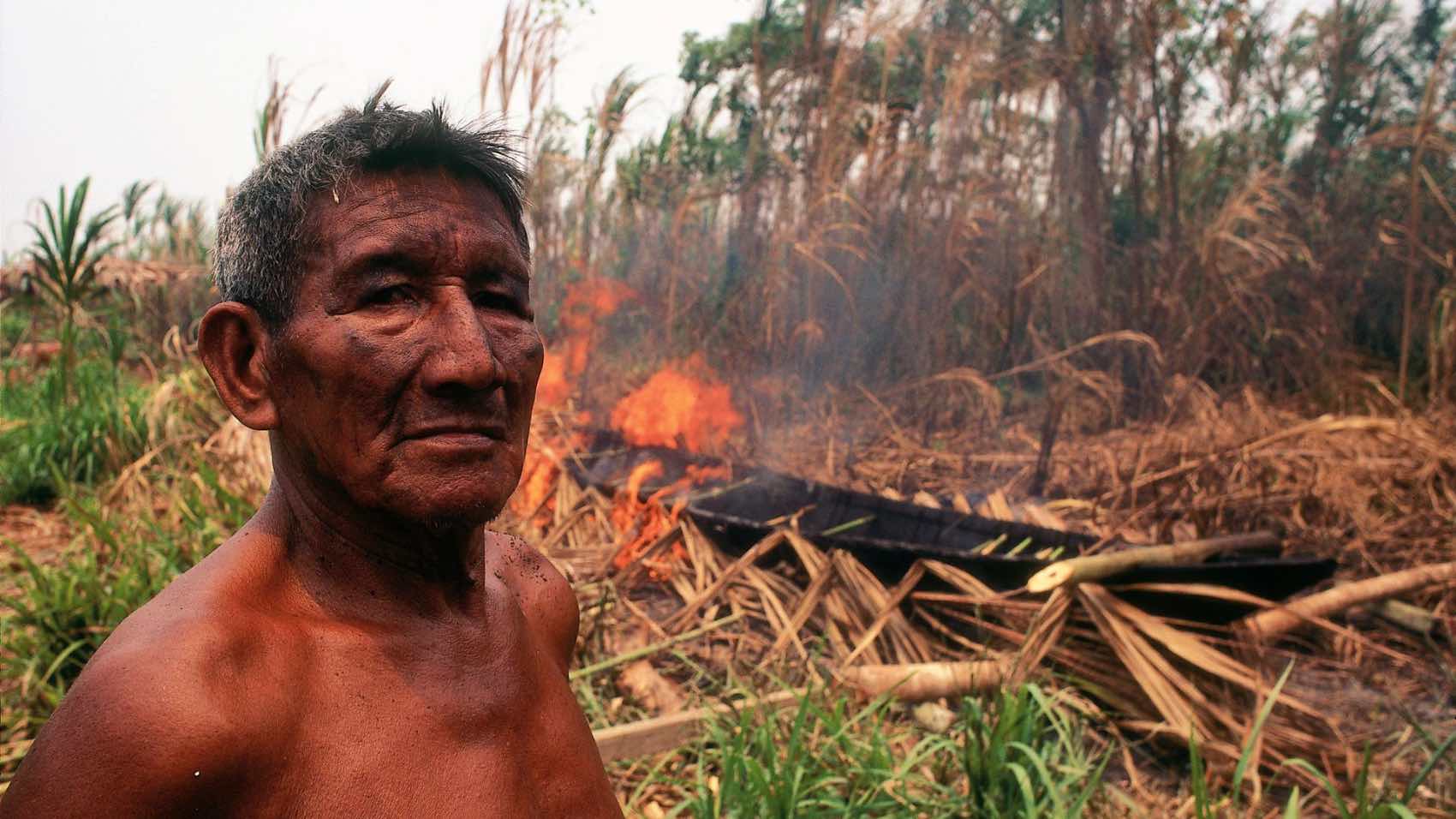
Pull a soil core from beneath almost any patch of the Amazon rainforest, and somewhere in it sits a black fleck of charcoal, the leftover ash of a fire that burned centuries or millennia ago. A new reconstruction built from 1,361 radiocarbon dates across 303 sites finds that charcoal is essentially absent before people reached the region and turns up almost everywhere once they do, meaning the rainforest’s entire 10,000 year fire history is really a record of human settlement, not a natural one. That finding upends a persistent myth about the Amazon: that fire, like the forest itself, has always simply been there. It hasn’t.
Ecologists have long treated the Amazon as one of the planet’s last big, untouched wildernesses, a green expanse where change comes from rainfall and river shift rather than human hands, an assumption a separate basin-wide survey of Amazonian tree distributions has already complicated for plant life specifically. The new radiocarbon record, published in Frontiers of Biogeography, argues that framing has never been quite right, at least where fire is concerned.
Tropical rainforest, it turns out, is not built to burn. Long before humans reached South America, glacial age lake and soil records from sites such as Serra Sul dos Carajás in eastern Amazonia and the Hill of Six Lakes in Brazil show charcoal that is either missing outright or present in only minuscule amounts, evidence that fire in these wet forests was a genuine rarity. At Campo Libre, a sediment core on the Andean slopes of Ecuador, fire is absent for a stretch of 30,000 years and then appears right around the time people show up, roughly 4,500 years ago. Because Amazonian plants evolved with almost no exposure to flame, most of them never developed much tolerance for it, a vulnerability confirmed by researchers tracking modern Amazon forest fires.

That vulnerability is precisely why the arrival of a fire-using species mattered so much. Once people reached the basin in the late Pleistocene, they carried fire into what the researchers describe as a naive landscape, one with no evolutionary memory of burning at all.
Fire Finds Its Way Into the Interior
The fire record that follows unfolds in three distinct pushes across roughly 10,000 years of Holocene history: early flames confined to the basin’s edges and the main channel of the Amazon River between 10,000 and 6,000 years ago, then a marked widening of both fire and settlement across most regions between 6,000 and 4,000 years ago, a spread that lines up with the earliest known maize cultivation in northwestern and southwestern Amazonia. By 2,000 years ago fire had reached even the deep interior of central Amazonia, a region that had stayed comparatively fire-free while its margins burned for thousands of years. Fire activity across the basin then peaked somewhere between about 1,300 and 500 years ago, the highest sustained burning the record shows.
Crystal McMichael, the University of Amsterdam ecologist who led the analysis, has spent years assembling exactly this kind of long, patchy record from soils and archaeological digs rather than lake mud, precisely because soil charcoal turns up almost everywhere, even where no lake exists to preserve a tidier timeline. It is unglamorous work, dating thousands of individual fragments one at a time, but it is what let this study cover ground that lake sediment reconstructions alone could not reach.
Turning thousands of individual radiocarbon ages into a single fire history takes some statistical care, because a raw pile of dates left unadjusted can manufacture false peaks wherever the calibration curve happens to flatten out. The team calculated summed probability distributions for the whole basin and for six separate regions, cross-checked the pattern against composite kernel density estimates built from a thousand random resamples of the dataset, and ran permutation tests to see whether any one region’s fire history strayed significantly from the basin-wide average. Northwestern Amazonia burned unusually hard between about 4,000 and 2,000 years ago, then fell quiet compared with everywhere else over the last 800 years. Central Amazonia ran the opposite course: fire stayed significantly below the basin average for most of the period between 7,000 and 2,000 years ago, then overtook other regions only in roughly the last 1,500 years. None of these regional wrinkles change the basin-wide pattern; they just show that the human fire story arrived on a different schedule in different corners of the forest.
None of this means fire remade the Amazon into something unrecognizable. The forest’s response was subtle rather than sweeping, nudging the balance toward species that were already there and simply tolerated flame better, palms being the clearest example.
The authors are careful about what the data can and cannot say: modern-era fires look strangely rare in the record, with only 13 of the 303 sites showing any post-1950 dates, and it is not clear whether that reflects genuinely less burning or just less disturbance at old archaeological sites in recent decades. They are equally candid that they do not know why fire first started dropping off, a few centuries before Europeans ever reached the river.
When the Burning Stopped, Twice
The decline itself came in two distinct waves. Fire frequency first fell across most regions somewhere around 700 to 500 years ago, several centuries before any European set foot in the basin, a pattern that supports what researchers call early abandonment, a wave of land use change or migration whose cause still is not settled. The second, steeper decline followed the first European expedition down the river in 1541, when disease, warfare and enslavement killed an estimated 90 to 95 percent of Indigenous Amazonians in what has become known as the Great Dying, a continent-wide collapse researchers elsewhere have linked to a dip in the planet’s atmospheric carbon dioxide. The paper’s authors argue that this 2,000 year restructuring of Amazonian fire has likely reshaped today’s forests on a scale that rivals major climatic shifts such as deglaciation, though they frame that comparison as probable rather than proven.
It leaves an odd question hanging over any plan to protect or restore the Amazon as it stands today: how much of the forest that people are trying to save was itself already shaped by earlier people, one careful burn and one abandoned field at a time. The rainforest photographed from space looks like wilderness, but the ground beneath it keeps a longer, more crowded memory.
Reference
McMichael, C. N. H., Heijink, B. M., Witteveen, N. H., Zwarts, A., & Bush, M. B. (2026). The pyrogeography of Amazonia: a Holocene perspective. Frontiers of Biogeography, 19. https://doi.org/10.21425/fob.19.169863
- Study type: Paleoecological and archaeological radiocarbon synthesis (peer-reviewed, Frontiers of Biogeography, June 2026), including newly generated dating
- Sample size: 1,361 radiocarbon dates across 303 sites (1,329 used in the main analysis; 31 newly dated for this study)
- Material examined: Charcoal fragments from soil cores and burned archaeological material
- Dating method: AMS radiocarbon dating, calibrated against IntCal20/SHCal20; summed probability distributions, kernel density estimates and permutation tests
- Period covered: Roughly the last 10,000 to 12,000 years of the Holocene
- Funding / conflicts of interest: European Research Council Starting Grant 853394 to the lead author; authors report no competing interests
- Data availability: Full dataset published as supplementary material with the article
- Main limitation: Author-stated: modern-era fires appear undercounted in the site record, and the cause of the initial pre-European decline in fire remains unknown
FAQ
If Amazonian plants never evolved with fire, why does the forest have fire-tolerant palms at all?
The forest has fire-tolerant palms because natural variation already existed among the plants that were there before people arrived, and repeated burning simply favored the individuals and species best able to survive it. Nothing needed to evolve specifically for fire; the new radiocarbon record suggests centuries of burning slowly filtered an existing plant community rather than creating a new one from scratch.
Could this record reflect wildfire caused by lightning or drought rather than people?
That seems unlikely, because the record shows almost no charcoal at all in the centuries before humans reached each site, even in naturally dry settings like the Andean slopes of Ecuador. That near total absence, followed by widespread charcoal once people show up, is what lets the researchers attribute the bulk of Amazonian fire history to human ignition rather than lightning or climate alone.
Why did Amazonian fire start declining before Europeans ever arrived?
Why it declined is still an open question. The record shows fire falling off across most regions roughly 700 to 500 years ago, well before any European reached the river in 1541, and the researchers connect this to a hypothesized wave of land use change or site abandonment sometimes called early abandonment. What triggered that shift is not something this radiocarbon record can settle on its own.
Does discovering fire’s human origins change how the Amazon should be protected today?
It complicates the picture, because it means much of what looks like ancient, untouched forest is partly the product of thousands of years of human burning and abandonment. That does not make the modern Amazon any less worth protecting, but it does suggest that unspoiled is the wrong word for a baseline that conservation planning might otherwise assume.


Cite This Page