

What the Study Found
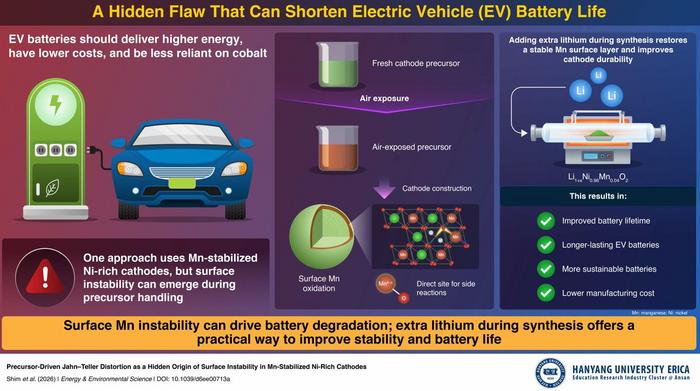
- Exposing hydroxide precursor to air oxidises surface manganese, seeding a defective shell that attacks the electrolyte once baked into a cathode.
- The air-exposed material lost capacity about twice as fast over 1000 cycles in a very-high-nickel model cathode (over 95% Ni).
- Full cells fell to 38% capacity retention after 700 cycles, against 63% for the vacuum-dried version.
- Tripling the excess lithium in synthesis suppressed the defect and restored over 90% capacity retention.
Leave the grey-green powder sitting out, and it turns brown. Not dramatically, not all at once, just a slow browning at the edges over weeks in an ordinary storeroom. It looks like nothing. A batch of hydroxide precursor, the raw stuff that gets baked into a battery cathode, ageing gently on a shelf. And yet that colour shift, it turns out, is the visible sign of a chemical betrayal that can roughly halve how long the finished battery lasts.
That is the finding from a team at Hanyang University in South Korea, working on the cobalt-free, nickel-rich cathodes that carmakers are betting on to push the range of electric vehicles up and their costs down. To catch the effect, the researchers built two matched samples, cathodes identical in every way but one: whether the precursor had been dried in vacuum or left to breathe ordinary air. The culprit they pinned down is manganese, which is normally the good guy.
Here is the setup. In these next-generation cathodes, engineers wrap a nickel-rich core in a thin manganese-rich shell. The nickel does the heavy lifting on capacity; the manganese is meant to sit on the surface as a bodyguard, holding the reactive nickel in check and keeping the whole particle stable. On paper, it’s a clean division of labor. The problem is that manganese, in its hydroxide form, is touchy about air.

Expose that precursor powder to an oxygen-rich atmosphere, even just the air in a warehouse, and the manganese at the surface starts to oxidise. When the material is later calcined into a cathode, that head start on oxidation sends the surface down a different chemical path.
What forms instead is a defective, spinel-like layer riddled with what chemists call Jahn-Teller distorted manganese. The name refers to a lopsided arrangement of the manganese-oxygen bonds, and the lopsidedness matters enormously. It weakens the bond between manganese and oxygen, and it leaves the oxygen atoms sitting there electron-rich and spoiling for a reaction.
“We found that a manganese-rich shell, which is normally introduced to protect high-nickel cathodes, can instead become a catalyst for degradation if the precursor chemistry is not carefully controlled,” says Jin Ho Bang, who led the work. “Even small variations in precursor storage history can substantially affect battery stability.”
Professor Jin Ho Bang from Hanyang University
How a Bodyguard Turns Saboteur
Those reactive oxygens are the heart of it. Acting as strong chemical bases, they go after the electrolyte, the liquid that ferries lithium ions back and forth inside the cell. They tear into the solvent molecules directly, and they also kick off a roundabout second attack: the distorted manganese sites generate water, which then hydrolyses the battery’s salt into corrosive by-products, including hydrofluoric acid. Manganese starts dissolving off the surface. And the damage does not stay put. Dissolved metal drifts across to the graphite anode on the other side of the cell, fouls it, and forces the battery to keep consuming its own lithium to patch up the mess. To pin the mechanism down cleanly, the team built a deliberately extreme model cathode, more than 95 per cent nickel, so the surface effect had nowhere to hide.
In that sensitive system the numbers are stark. The air-exposed material shed capacity about twice as fast over a thousand charge cycles as its vacuum-dried twin. In full cells paired with graphite, the vacuum-dried cathode still held 63 per cent of its capacity after 700 cycles; the air-exposed one had collapsed to 38.
A fair question is whether any of this survives contact with a real production line, where cathodes rarely run at more than 95 per cent nickel. The authors are candid that they cranked the nickel up on purpose, to isolate a mechanism that would be subtler, though still present, in a commercial mix. So the two-fold figure is a spotlight, not a spec sheet.
A Splash More Lithium
What makes the work more than a warning is that the same chemistry points to a cheap fix. Because the defect grows when the surface is starved of lithium during baking, the team simply added more: a threefold bump in the excess lithium fed into the synthesis. That was enough to smother the defective phase and coax the manganese-oxygen bonds back into their stable, protective form. Cathodes made this way clung on to more than 90 per cent of their capacity. No exotic coatings, no rebuilt factory, just tighter control of two things a plant already handles, how the precursor is stored and how much lithium goes in.
If the effect holds in commercial chemistries, and the direction seems likely even if the size does not, the lesson for manufacturers is oddly mundane. Watch the powder. A battery’s fate may be sealed months before anyone assembles a cell, decided by something as unglamorous as whether a tub of precursor was left breathing the wrong air.
- Study type: Experimental materials-science and electrochemistry study; peer-reviewed, published in Energy & Environmental Science (Royal Society of Chemistry). A correction to the article has since been published.
- Sample size: Not a sampled population. Two matched cathode sample sets compared (vacuum-dried vs air-dried precursor), plus lithium-excess variants, characterised across structural and electrochemical techniques.
- Exposure: Precursor drying atmosphere, oxygen-rich air versus vacuum, with an aged set stored six months at ambient humidity.
- Comparison group: Vacuum-dried precursor cathode (LCS-NM) as the low-oxidation reference against the air-dried counterpart (HCS-NM).
- Test conditions: Coin-cell cycling to 100 cycles (half-cell) and 700 to 1000 cycles (full-cell paired with graphite); model composition 96% Ni, 4% Mn, deliberately run above 95% Ni to isolate the surface effect.
- Funding / conflicts of interest: National Research Foundation of Korea, funded by the Ministry of Science and ICT and the Ministry of Education. Authors declare no conflicts.
- Data availability: Supporting data included in the supplementary information (see DOI).
- Main limitation: The headline degradation figures come from a deliberately extreme over-95% nickel model system chosen to amplify the mechanism, so the effect is expected to be milder, though still present, in typical commercial cathodes.
Reference
Shim, J., Yu, Y. G., Choi, Y. B., & Bang, J. H. (2026). Precursor-driven Jahn–Teller distortion as a hidden origin of surface instability in Mn-stabilized Ni-rich cathodes. Energy & Environmental Science, 19(12), 3845–3864. https://doi.org/10.1039/d6ee00713a
Frequently Asked Questions
Why does leaving battery precursor exposed to air matter so much?
Leaving battery precursor exposed to air matters because the manganese on its surface starts to oxidise before the material is ever baked into a cathode, and that head start pushes the surface into a defective structure once it is heated. In the Hanyang team’s very-high-nickel test cathodes, that hidden change roughly doubled how fast the battery lost capacity over long cycling. The damage is essentially locked in months before a cell is assembled.
Is it true that manganese, which is meant to protect the cathode, can cause the damage instead?
It is true that manganese can cause the damage instead of preventing it. Manganese is normally added as a stable shell to shield the reactive nickel core, but when air exposure warps its bonding into a lopsided, so-called Jahn-Teller distorted form, that same shell turns into a chemically aggressive surface that attacks the electrolyte and dissolves away. Its protective role depends entirely on the chemical state it ends up in, not just on it being present.
How does the lithium fix actually work?
The lithium fix works by feeding extra lithium into the synthesis, about three times the usual excess, so the surface is no longer starved of it while the cathode is being baked. That surplus suppresses the defective phase from forming and coaxes the manganese-oxygen bonds back into their stable, protective arrangement. Cathodes made this way held on to more than 90 per cent of their capacity in the team’s tests.
Does this mean electric car batteries are already failing early because of this?
This does not mean electric car batteries are already failing early because of it. The dramatic numbers came from a deliberately extreme test cathode running at more than 95 per cent nickel, chosen to make a subtle effect easy to see, rather than from a typical commercial cell. The mechanism is likely present to some degree in real cathodes, but its size in everyday batteries has not been measured here.
What’s stopping manufacturers from simply avoiding this problem?
What’s stopping manufacturers is mostly a matter of awareness and process control rather than any expensive barrier. The fix needs no new coatings or redesigned production lines, just tighter handling of how precursor powder is stored and how much lithium is added during synthesis. The catch is that the problem is invisible on a normal spec sheet, so a plant has to know to watch for it in the first place.


Cite This Page