What the Study Found
- A spin glass built from cold atoms and light held up to 25 memories in a 16-spin network, seven times a standard network’s 3.6.
- At standard trap strength the same setup averaged 11.9 memories versus 3.6 for a conventional network, still over three times as many.
- The atoms shifted position after each recall, a short-term plasticity echoing how brain synapses adjust during learning.
- The demonstration runs only in an ultracold vacuum chamber; physicists call it an early proof of principle, not a scalable memory chip.
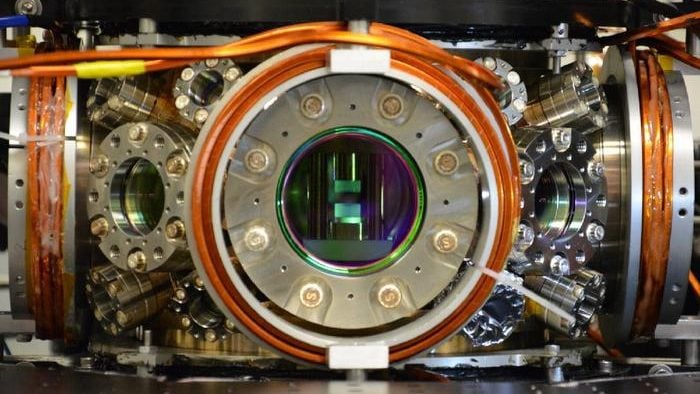
Inside a vacuum chamber at Stanford University, clusters of ultracold rubidium atoms sit trapped by laser tweezers while pulses of light ricochet between two curved mirrors only centimetres apart. Each cluster, tens of thousands of atoms acting as a single quantum unit, flips between two states the way a compass needle points north or south, and the light bouncing overhead wires the clusters together into one frustrated network. Physicists at Stanford have built an artificial memory from a notoriously disordered magnetic state called a spin glass, and the resulting device can hold several times as many memories as a conventional network built to the same size. It sounds like a magic trick, since a spin glass is usually where memory goes to die.
Every large language model chatting away today descends, however distantly, from an idea about memory that won a Nobel Prize. John Hopfield showed physicists and computer scientists alike, back in 1982, that a network of interconnected switches could store and retrieve whole memories from partial clues, the same trick your brain performs when it recognizes a friend’s face through a foggy window, work that later earned him a share of the 2024 Nobel Prize in Physics.
A refrigerator magnet works because every atomic spin inside points the same way, up or down, which is why it clings stubbornly to the door. A spin glass is the opposite: the spins get frustrated, stuck pointing in conflicting directions, so the material behaves like everyday glass, solid to the touch but with its atoms frozen in a disordered, fluid-like jumble. Hopfield showed that a similar tangle of interconnected spins, wired up correctly, settles into low-energy valleys, and each valley can represent one complete memory pattern; feed the network a corrupted version of a pattern and it rolls downhill to the nearest valley and completes it. The trouble starts when you cram in too many memories: past a certain point the network itself turns into a spin glass, and the resulting energy landscape gets so cluttered with false valleys that recall falls apart.

For four decades, that has been read as a hard limit: once a Hopfield network turns glassy, it is finished as a memory device, and researchers work hard to avoid triggering it. Lev’s team asked what would happen if you built the spin glass on purpose, out of atoms and photons, and let quantum effects handle the recall instead of ordinary equilibrium physics.
The Glass Becomes a Feature
The idea traces back to a 2025 Science paper from the same group, which first built this quantum-optical spin glass in the lab but had not yet tried using it to remember anything. This time, the researchers arranged clusters of 10,000 or more ultracold rubidium atoms, each cluster acting as a single Bose-Einstein condensate, or super atom, inside the optical cavity, and let photons bouncing between the mirrors carry signals between them, standing in for the synapses that connect real neurons. Those photon-mediated connections nudge every atomic cluster’s spin up or down until the whole network settles into one of the spin glass’s low-energy valleys, the same downhill process Hopfield described, just running on quantum-optical rather than purely equilibrium physics.
“We can now make neural networks at the atomic level, and they adjust themselves in a way that is somewhat similar to how we believe our brains learn,” says Benjamin Lev, the study’s senior author and a professor of physics and applied physics at Stanford. It is the kind of sentence that sounds like hyperbole until you watch the recall happen: feed the network a smudged version of a stored pattern, and within a few milliseconds the atoms sort themselves back into the original.
In the experiment, the team built networks as small as four spins and as large as sixteen, running five different wirings of each size and testing each wiring across as many as 400 recall attempts, with every reported recall curve averaged over 30 trials. Each surviving memory needed a basin size of at least one spin flip to count, and among the roughly 51 candidate patterns the sixteen-spin networks produced, one wiring held 14 memories on its own, while averaging in results from four other independently wired networks brought the group average to 11.9. That average is already more than three times what a conventional Hopfield network manages at the same size, a comparison figure of 3.6 the researchers use throughout, but the real headline number came from tweaking the physical trap itself. Weaken the laser tweezers holding the atoms in place, cutting their power by a factor of four, and the atoms become freer to drift as they settle into a memory, deepening the energy valley they land in. Under that softer trap, the same sixteen-spin network held 25 memories, seven times the Hopfield number and the figure that made the headlines.
A Softer Trap, a Different Trade
That sevenfold figure describes the softer, deliberately weakened trap, not the everyday setting: run at standard trap strength, the same size network averaged 11.9 memories against a Hopfield figure of 3.6, a smaller but still real advantage. The softer trap also made recall a little less forgiving, with an average basin size of 2.1 spin flips instead of the Hopfield model’s 3.9, so what quantum-optical spin glasses gain in capacity, they give up somewhat in robustness.
The team is also careful not to claim they have proven exactly why the trick works: they suspect a kind of steepest-descent dynamics, a more decisive downhill roll toward each memory than ordinary thermal jostling allows, but confirming that would mean directly watching the spins evolve in time, something they have not yet done. Nor have they shown the effect at any real scale: the biggest network fully catalogued for capacity held sixteen spins, and a lone twenty-spin version, demonstrated but not exhaustively measured, hints at where the scaling limits might start to bite.
None of this makes a rival to today’s silicon-based AI hardware, at least not yet, since the whole apparatus lives inside a vacuum chamber chilled far below room temperature. “We now have a proof of principle of a physical network that adjusts itself in a way a learning system would, and if we can improve and scale that up, AI hardware might become far less power hungry to train,” Lev says, a real concern given how much electricity AI training and inference already draw worldwide. The atoms’ habit of physically shifting position after each recall, a kind of short-term plasticity, echoes the way synapses between real neurons briefly strengthen or weaken as the brain learns, which is precisely the property that let this system beat its Hopfield rival in the first place. That resemblance is doing real work here, not just supplying a metaphor: it was the atoms’ freedom to drift, not any change to the wiring diagram, that reshaped the memory landscape and produced the extra capacity.
“This teaches us a little bit more about how physical systems can compute, not just with the classical laws of physics, but also with quantum laws,” Lev says, and the team is already working on networks with more spins, some of them quantum entangled, to see how far the trick extends. “It’s great to shoot for these applications, but we’re also doing this because we want to know more about how nature works,” he adds, which is either the most honest thing a physicist can say about an AI paper, or the quietest kind of ambition there is.
Reference
Marsh, B. P., Schuller, D. A., Ji, Y., Hunt, H. S., Ganguli, S., Gopalakrishnan, S., Keeling, J., & Lev, B. L. (2026). High-capacity associative memory in a quantum-optical spin glass. Science. https://doi.org/10.1126/science.aec3917
- Study type: Peer-reviewed experimental physics study (quantum-optical spin-glass associative memory), Science, published 3 Sep 2026.
- Sample size: Networks of 4, 8, 12 and 16 spins tested, five disorder realizations per size; 16-spin capacity averaged 11.9 memories at standard trap settings, up to 25 with a weakened trap. A single 20-spin network was also demonstrated.
- Apparatus: Ultracold rubidium Bose-Einstein condensates (super atoms) held by optical tweezers inside a multimode optical cavity, coupled by cavity photons.
- Benchmark: Compared against the Hopfield model under Hebbian learning and against simulations of the Sherrington-Kirkpatrick spin-glass model.
- Funding / conflicts of interest: US Army Research Office, US DOE Q-NEXT, UK EPSRC, Stanford QFARM Initiative, Stanford Shoucheng Zhang Graduate Fellowship, Schmidt Science Polymath program. Authors declare no competing interests.
- Data availability: Primary data publicly available via the Harvard Dataverse Repository; additional data available on reasonable request.
- Main limitation: Full capacity statistics were characterized only up to 16-spin networks; a 20-spin network was demonstrated but not exhaustively catalogued, since doing so becomes prohibitively time-consuming as network size grows.
FAQ
Could this quantum-optical memory replace the chips in a laptop or phone?
Not any time soon. This memory only exists inside a vacuum chamber, with atoms cooled to nearly absolute zero and a delicate arrangement of lasers and mirrors, so it is a research demonstration rather than something you could buy. The researchers describe the work as an early proof of principle, useful for understanding a new physical mechanism rather than a finished piece of hardware.
Why would making a network glassier improve its memory instead of ruining it?
In an ordinary Hopfield network, turning glassy usually wrecks recall, because the network settles into a jumble of false memory valleys instead of real ones. This quantum-optical version escapes that trap by running on nonequilibrium, photon-driven dynamics that roll more decisively downhill toward a single valley, turning what would otherwise be a spurious pattern into a usable memory rather than noise.
Is the sevenfold memory boost the normal result, or a special case?
It is a special case. The sevenfold advantage over a standard Hopfield network only showed up once the researchers deliberately weakened the optical traps holding the atoms, letting them drift more freely during recall. At the standard trap strength used for most of the experiment, the same size network still beat a conventional one, averaging 11.9 memories against 3.6, just not by as wide a margin.
How does short-term plasticity help the network remember more?
Short-term plasticity refers to the atoms slightly shifting position each time the network recalls a memory, which briefly reshapes the connections between them, much like synapses between real neurons strengthen or weaken during learning. That drifting turned out to be the very thing boosting memory capacity, hinting that physical, self-adjusting hardware might one day need less outside tuning, and less power, to learn.


Cite This Page