
What the Study Found
- Dog brain rhythms locked onto hidden words more tightly for consonant-structured speech, as human ones did (20 dogs, 20 people).
- The dog bias also appeared in 9 dogs presumed to have started life outside a speech-rich home, though that group is small.
- Across 21 wild orangutans, social learning was about five times as frequent as solo learning, and watching shaped exploring for about 2.5 hours.
- Orangutans high in both social and solo learning ended with the broadest diets; social learning offset low solo effort (13 animals).
NOTHING in the stream said where one word ended and the next began. Syllables arrived at four a second, consonants and vowels trading places, and the only clue to the hidden words, where there were any, was which sounds kept coming back: a puzzle set for 20 people and 20 companion dogs wearing electrodes on the scalp. Two studies in the same issue of Science, one on dogs and one on wild orangutans, suggest that abilities we treat as human signatures may rest on learning machinery far older, and far more widely shared, than we are. The dogs supplied the cleaner experiment; the orangutans supplied the longer story.
Underneath both papers sits an old puzzle about human uniqueness. How much of what we do so well, talking and passing on culture, is special equipment, and how much is ordinary animal learning given a great deal of practice?
The Dogs Went for the Consonants
Humans lean on consonants to find the edges of words, even though vowels are the louder, more prominent sounds; babies start out favoring vowels and shift toward consonants by around their first birthday. “Although vowels are louder and more noticeable, consonants usually form the skeleton of words,” says Attila Andics, a cognitive neuroscientist at Eötvös Loránd University in Budapest who led the work. His team built three kinds of stream from three-syllable nonsense words: words that shared their consonants while the vowels varied freely, words that shared their vowels while the consonants varied, and a control with no recurring words at all. Nothing marked a boundary in any of them, so a brain that found the words had to do it from pattern alone, as infants of eight months have been shown to do with made-up words, and the researchers watched for it as the rhythm of the recorded electrical activity locking on to the rhythm of the hidden words.

Vowels carried more acoustic energy in every stream, so loudness cannot explain what came next. In dogs and in people alike, the brain’s rhythm locked onto the hidden words more tightly for consonant-structured streams than for either of the other two.
Then came the question of where the bias comes from. Dogs are spoken to daily, but they differ in when they start living in a speech-rich home, and 9 of the 20 were presumed, from their age at adoption and how they were raised, to have spent the first 12 weeks or so outside a speech-rich home; the other 11 were presumed to have had homes from the start. The bias turned up in both groups, and the early group showed no bigger effect than the late one.
Boglárka Morvai, a biologist and postdoctoral researcher on the team, says the logic of the test ran against the dogs: if a consonant preference needs uniquely human language abilities to develop, then “other species should not show such a preference. Not even dogs, despite spending much of their lives surrounded by human speech.” The dogs showed one anyway.
The two species did not match everywhere. People also picked up the vowel-defined words, though less strongly than the consonant ones, while the dogs showed no sign of them. Rhythm at the level of individual speech sounds appeared in the human recordings and not the canine ones, which fits the idea that people track single sounds while dogs treat the syllable as the smallest unit; the authors suggest that this second route may give humans a way into vowel patterns that dogs lack.
The fine print matters. The study is small, with 9 dogs in the late-arrival group and incomplete information about where those dogs spent their first weeks (a release places them on the street or in a shelter as fact; the paper calls it a presumption and urges caution), and the authors leave open whether the bias reflects domestication or a hearing ability older than dogs’ time with us. Their own view is that the older, general ability looks unlikely, since barks and other noisy, consonant-like calls seem to have become prominent in canine communication mostly during domestication.
Eight Years of Watching and Trying
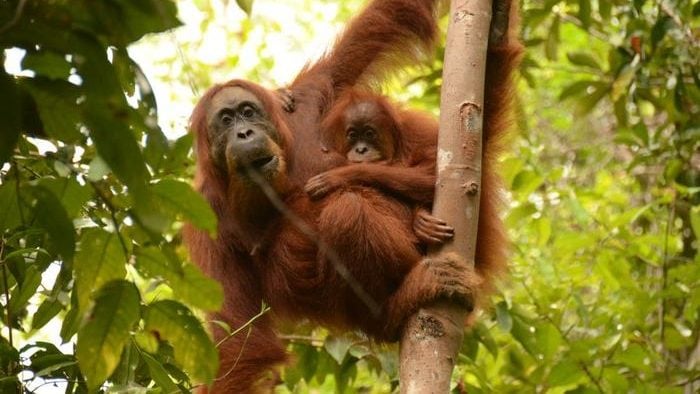
An infant orangutan in Sumatra spends about eight years at its mother’s side, and by the end it needs to know roughly 250 food items, chosen from thousands of options in the forest, some potentially toxic, many needing processing before they can be eaten, a few needing a tool. Researchers at the Max Planck Institute of Animal Behavior in Germany went to the long-term record from the Suaq Balimbing research station in Gunung Leuser National Park, Indonesia, where the resident animals have been followed for 12 years. In an observational analysis of 21 animals from birth to independence, they tracked two behaviors: peering, the sustained close watching of what another animal does, which they took as a sign of social learning, and exploration, the hands-on handling of objects, taken as a sign of individual learning. An earlier estimate puts the peering habit at around 40,000 episodes in a lifetime.
Once explorations that followed closely on peering were counted as socially driven, going it alone turned out to be rare: social learning was about five times as frequent. A single episode of peering left a long shadow, too, with the animals’ exploring staying tied to what they had watched for as long as two and a half hours. “Each time an infant peered, it had a prolonged, ripple effect on subsequent explorations,” says Revathe Thillaikumar, a postdoctoral fellow at the institute and the paper’s lead author. (Some infants peered far more than others.)
The payoff showed up in diet breadth at independence, scored for 13 of the animals. Infants with high social and high individual learning tendencies ended up with the broadest diets, and social learning appeared to compensate when the solo effort was low: among the low explorers, heavy social learners had diets about 1.5 times as broad as their lower-peering peers, against about 1.2 times among the high explorers. “Social learning stepped in to do the heavy lifting,” Thillaikumar says.
None of this is an experiment. One forest, 13 animals on the diet outcome, and no way to say whether genes, mothers or circumstance make one infant a watcher and another a tinkerer. The compensating effect also comes with a wide margin of error, and one release says the young acquired five to six times more knowledge socially than alone, when the paper counts how often the behaviors occur, not how much knowledge results.
Old Machinery, Human Results
The two teams studied different animals by different methods, and each draws its own conclusion. Set side by side, though, a pattern shows. In dogs, a bias that had been found in people and not in other primates appeared in a species whose ancestors never spoke, and the authors think pattern learning and everyday exposure to speech may be enough to explain it. In orangutans, the breadth of a diet at independence tracked how much an infant watched and how much it tried, across years, with the mother as the curriculum.
Neither result says humans are ordinary. The dog paper found humans tracking finer detail than dogs did, and what the orangutan authors report is that great ape cultural learning sits closer to the mechanisms of human culture than had been appreciated, not that the two match. What both suggest is that general tools, for spotting regularities, which rats can manage in a simple form with speech streams, and for borrowing from others, which a public database of animal culture now catalogs across dozens of species, pointed at a rich enough environment, can do work we once assigned to faculties found only in us.
The orangutan team next wants to know whether heavier learners take in more energy and, in the end, survive and reproduce better; co-author Sri Suci Utami-Atmoko says such questions “can only be answered by watching animals in their natural environment from birth to death.” The dog team is left with theirs: whether a dog’s readiness for consonants is something each dog learns, or something domestication handed the whole species.
Reference
Morvai, B., Tóth, K. G., Boros, M., Rácz, D. S., Iotchev, I., Szabó, K., & Andics, A. (2026). Neural evidence that dogs segment the speech they hear with a humanlike consonant bias. Science, 393(6818), 1354–1358. https://doi.org/10.1126/science.adw7709
Revathe, T., Weidling, M.-T., Utami-Atmoko, S. S., Setia, T. M., Razik, I., van Schaik, C. P., Whiten, A., Bürkner, P.-C., & Schuppli, C. (2026). How 8 years of social and individual learning interact to shape ecological competence in orangutans. Science, 393(6818), 1369–1374. https://doi.org/10.1126/science.adz6415
- Study type (dogs): Peer-reviewed experimental study in Science (vol 393, issue 6818); within-subject comparison of three speech-stream conditions in two species
- Sample size (dogs): 20 adult companion dogs (11 presumed early and 9 presumed late onset of a speech-rich home) and 20 adult humans
- Conditions (dogs): Continuous streams of three-syllable nonsense words with recurring consonant patterns, recurring vowel patterns, or no recurring words; no pauses or cues at word boundaries
- Measures (dogs): Scalp electroencephalography (EEG): word-rate neural entrainment (intertrial coherence) and event-related potentials 350–550 ms after word onset
- Session length (dogs): Not reported in the main text
- Funding / conflicts of interest (dogs): European Research Council, Hungarian Academy of Sciences National Brain Programme, EU Marie Skłodowska-Curie grant, Hungarian national innovation fund; authors declare no competing interests
- Data availability (dogs): Data, code and materials on Figshare
- Preregistration (dogs): Not reported
- Main limitation (dogs): Author-stated: small sample and incomplete pre-adoption information for late-onset dogs warrant caution; whether the bias reflects domestication or an older ability is left open
- Study type (orangutans): Peer-reviewed observational field study in Science (vol 393, issue 6818); Bayesian mixed-effects models of individual learning tendencies and diet breadth
- Sample size (orangutans): 21 wild immature Sumatran orangutans (2113 peering and 4649 exploration events); diet breadth scored for 13 of them (303 distinct food items)
- Exposure (orangutans): Each animal’s average rate of peering (social learning) and of exploration counted as independent of prior peering (individual learning)
- Comparison group (orangutans): Animals with lower versus higher learning tendencies, adjusted for age, sex, food availability and number of association partners
- Follow-up (orangutans): Animals followed from birth to independence at about 8.5 years; 12 years of field data, over 1700 observation hours for learning events and about 4700 hours of diet scans
- Funding / conflicts of interest (orangutans): Marie Skłodowska-Curie fellowship, Max Planck Institute of Animal Behavior, University of Zurich, Leakey Foundation, Volkswagen Stiftung and others; authors declare no competing interests
- Data availability (orangutans): Data and code on the Dryad repository
- Preregistration (orangutans): Not reported
- Main limitation (orangutans): Author-stated: causes of individual differences unknown; the 145-minute cutoff for independent exploration was empirically derived. Not author-stated: one site, and 13 animals for the diet outcome
FAQ
Does a dog’s consonant bias mean dogs understand what we say?
A consonant bias in dogs does not mean they understand speech. The dogs heard made-up words, and the researchers measured whether the brain’s electrical rhythm locked onto hidden word patterns, not whether the dogs grasped any meaning. What the result suggests is that dogs pick out patterns in speech in a way that resembles how people do.
Why would a dog’s brain favor consonants if dogs never speak?
A dog’s brain may favor consonants because pattern learning from speech heard every day is enough to produce the bias. The bias showed up even in dogs presumed to have started life outside a speech-rich home, and the authors suggest that regular exposure may be sufficient. They also leave open whether domestication played a part, though they think an older, general hearing ability looks unlikely.
Do young orangutans learn mostly by copying their mothers?
Young orangutans lean heavily on watching others, but copying alone does not explain their diets. Social learning was about five times as frequent as learning alone, and watching shaped later exploring for as long as two and a half hours. The infants with the broadest diets were the ones high in both social and individual learning.
Could an orangutan infant make up for too little exploring by watching more?
An orangutan infant that explores little on its own may partly make up for it by watching more, according to the data. Among low explorers, heavy social learners had diets about 1.5 times as broad as lower-peering peers, against about 1.2 times among high explorers. The study is observational, covers 13 animals on the diet outcome, and the effect carries a wide margin of error.
Does this mean humans are not special after all?
Humans are not shown to be ordinary by these studies. People in the dog experiment also picked up vowel patterns and tracked individual speech sounds, which the dogs did not, and the orangutan authors report that ape cultural learning is closer to the mechanisms of human culture than had been appreciated, not that the two match. What both suggest is that general learning tools do work once assigned to faculties found only in humans.


Cite This Page