
What the Study Found
- A floating plant raft cut a wastewater lagoon’s combined greenhouse gas emissions by 22 to 31 percent over two years.
- Methane fell hardest, from about 0.01 down to 0.004 grams per square metre daily at the channel’s start – a 66 percent drop.
- Carbon dioxide and nitrous oxide also declined, by up to 36 percent and 18 percent, within four to seven months of installation.
- Nutrient levels barely budged: nitrogen dropped just 12 percent, and phosphorus and nitrate showed no measurable change at all.
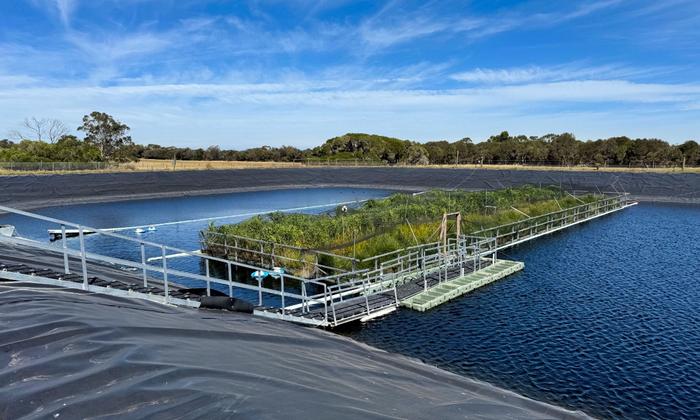
Out on Phillip Island, in southeastern Australia, a raft of native reeds and sedges floats across a wastewater lagoon, covering about 7 percent of its surface, roots trailing down into water thick with nutrients and dissolved gas. A two-year trial there found that the floating plants cut the lagoon’s combined greenhouse gas emissions by up to 31 percent, and the cuts started showing up months before the water carried any less nitrogen. The reductions traced back to the plants’ root systems, where dense microbial communities appear to consume the gases directly rather than waiting for the plants themselves to strip nutrients from the water. That timing surprised the research team, because floating wetlands are usually installed, and judged, for their ability to clean water rather than clear the air.
Wastewater treatment causes roughly 1.6 percent of the world’s greenhouse gas output, on par with global aviation, according to a UN analysis of the sector. Methane and nitrous oxide, both far more potent heat-trappers than carbon dioxide, make up a disproportionate share of that footprint.
Most of that gas, an amount a separate US mobile-lab study published this year suggests official inventories still undercount, comes from microbes breaking down the nitrogen and organic matter in wastewater: respiring carbon dioxide, producing methane in low-oxygen pockets, converting nitrogen compounds into nitrous oxide. Enclosed treatment stages can capture some of this, burning off methane for energy, but the open holding lagoons where treated water lingers before reuse or discharge have no such option. Floating wetlands have been used for years to pull nitrogen and phosphorus out of exactly these kinds of ponds, their roots offering microbes a surface to colonise. Nobody had measured, at full operational scale, whether the same rafts might also throttle the gases those microbes give off.

Two Channels, One Splitter Box
To find out, the team divided a treatment lagoon at the Westernport Water plant into two channels using vinyl curtains anchored to the lagoon bed, one left untouched as a control and the other fitted with the floating wetland. A splitter box fed both channels the same incoming water, so any difference between them could be pinned on the wetland rather than on one side simply receiving dirtier water.
Before the wetland went in, a month of baseline monitoring showed the two channels behaved almost identically, with gas fluxes and water quality differing by less than 6.7 percent between them. For the next two years, floating sensors logged hourly gas readings at the start and end of each channel, and 84 monthly water samples tracked nitrogen and phosphorus, eventually yielding 412 flux estimates for carbon dioxide alone. The wetland itself grew across 331 square metres of the lagoon’s surface, planted with three native species whose roots dangled straight into the flow.
“This is the first time we’ve had evidence on this scale that supporting microbial communities in the root systems of wetland plants can reduce wastewater emissions without relying on high-tech solutions,” says Lukas Schuster, the study’s first author at RMIT University. It is, he adds, a demonstration that a patch of reeds can do a job usually reserved for aeration systems and gas-capture equipment.
The mechanism the team proposes is less about scrubbing nutrients from the water and more about intercepting gas before it escapes: dense biofilms on the submerged roots host methane-eating bacteria and algae capable of consuming carbon dioxide and nitrous oxide, effectively catching greenhouse gases at the point of production. The floating mat itself may help too, since covering part of the surface calms the wind-driven turbulence that normally pumps dissolved gas out of the water and into the atmosphere. Over the full two years, methane fell 32 to 66 percent depending on where in the channel it was measured, carbon dioxide dropped 24 to 36 percent, and nitrous oxide declined by 18 percent, though that last figure sat right at the edge of statistical significance. Combined into a single carbon dioxide equivalent figure, overall emissions from the treatment channel came in 22 percent lower than the control across the full study, or 31 percent lower once the researchers set aside short-lived spikes tied to routine plant harvesting. Those spikes were real: cutting back the reeds sent methane readings as high as 12.5 times the control channel’s levels, before they settled back down within a month.
The Nutrients Lagged Behind
Nutrients told a slower story. Total nitrogen in the water fell by only 12 percent over the full two years and did not become detectable until 12 months after installation. Phosphorus and nitrate, meanwhile, showed no change the researchers could measure.
The lagoon’s short retention time may be to blame: water moved through each channel in under ten hours, hardly long enough for roots and biofilms to strip out much dissolved nitrogen, even if it was plenty of time to intercept escaping gas. The trial also covered a single lagoon with a single wetland design, so the size of the effect elsewhere, in ponds with slower flow or fuller plant coverage, remains untested.
“The outcomes provide a strong foundation for further work to test performance across additional lagoon types and operating conditions,” says Dona Tantirimudalige, managing director of Westernport Water, which hosted the trial. A floating wetland can be retrofitted into a lagoon that already exists, unlike aeration or gas-capture infrastructure. It is not free: this one cost the equivalent of about 567 US dollars per square metre to build and roughly 70 US dollars per square metre a year to run. CSIRO, a trial partner, is already adapting the technology for farm dams, hoping the same trick might work across Australia’s 1.8 million agricultural ponds.
Whether floating rafts of reeds can meaningfully dent a global 1.6 percent slice of emissions depends on scaling far beyond one lagoon in southeastern Australia, across sites the team has not yet tested. For now, the roots are doing something a wastewater engineer would not have predicted: catching greenhouse gases on their way out, long before they get around to cleaning the water they are sitting in.
Reference
Schuster, L., Macreadie, P. I., Awad, J., Navarro, D., & Malerba, M. E. (2026). Constructed floating wetlands cut greenhouse gas emissions from wastewater lagoons. Journal of Environmental Management, 415, 130663. https://doi.org/10.1016/j.jenvman.2026.130663
- Study type: Peer-reviewed journal article (Journal of Environmental Management, open access), full-scale paired-channel field trial with baseline verification (quasi-experimental, non-randomised).
- Sample size: 1 lagoon, 2 channels (treatment vs control), 21 of 24 months monitored; 412-428 gas-flux estimates per gas, 84 water-quality samples.
- Exposure: Constructed floating wetland, 331 m2 (about 7 percent of the lagoon surface), installed May 2023.
- Comparison group: Adjacent unmodified control channel in the same lagoon, receiving equal inflow via a splitter box.
- Duration: 24-month trial, April 2023 to April 2025 (4 months of data gaps for weather-related access and logistics).
- Funding / conflicts of interest: Westernport Water, the Victorian Government, Intelligent Water Networks and Yarra Valley Water; two authors hold ARC fellowships. Authors declare no competing interests.
- Data availability: Full dataset publicly available on Figshare (DOI 10.6084/m9.figshare.33196770).
- Main limitation: Single lagoon, single CFW design and vegetation mix (author-stated); findings may not generalise to lagoons with different retention times or coverage levels.
FAQ
Could floating wetlands be retrofitted into existing wastewater ponds?
Yes, that is one of the appeals researchers point to: because the raft simply floats on an existing lagoon, a utility can add one without rebuilding infrastructure or shutting a pond down. The Phillip Island trial cost roughly 567 US dollars per square metre to install, which is far less than the aeration or gas-capture systems most treatment plants would otherwise need to cut emissions.
Do floating wetlands remove other pollutants besides greenhouse gases?
Related research suggests they can. CSIRO researcher John Awad notes the same root systems that appear to trap greenhouse gases are also being studied for their ability to intercept contaminants such as PFAS and heavy metals in other floating-wetland projects, though this particular two-year trial measured nutrients and greenhouse gases only, not those other pollutants.
Why did the greenhouse gas cuts show up before the nutrient reductions did?
The researchers suspect the two processes run on different clocks. Trapping and consuming gas appears to happen quickly in the biofilms coating the submerged roots, while pulling nitrogen out of the water depends on slower uptake by plant tissue and microbes, which in this short, fast-flowing lagoon took a full year to become measurable.
What is stopping floating wetlands from being installed everywhere already?
Mainly a thin evidence base and upfront cost. This is one of the first full-scale, two-year trials to isolate a wetland’s effect on emissions specifically, so water utilities have little data yet on how performance holds up across different lagoon sizes, climates and retention times. Researchers, including a follow-up trial now underway in farm dams along Victoria’s Bass Coast, are working to build that evidence out.


Cite This Page