What the Study Found
- Wind speeds fell as host-galaxy metallicity fell across 29 O stars, a trend traced from about 50% down to 5% of solar.
- Below about 10% of solar, winds fell off more steeply than the smooth trend predicts, based on 15 stars; the authors call it tentative.
- At the same spectral type, stars in less metal-poor galaxies showed stronger iron absorption, implying a real spread in iron content.
- Eight of 29 stars (28%) move out of step with their galaxy’s rotation, marking them as candidate runaway stars.
A massive star sheds its skin with the help of borrowed metal: ions of carbon, oxygen and iron soak up its fierce ultraviolet light, and the push they get flings gas off the surface at speeds of thousands of kilometers per second. With less metal on board, that push ought to weaken. The winds of massive stars poor in metals matter far beyond the stars themselves, because the models astronomers use to read the light of the James Webb Space Telescope’s early galaxies take much of their stellar physics from metal-rich stars, and a Hubble Space Telescope survey of 29 massive stars in six nearby dwarf galaxies hints that below about 10 percent of the Sun’s metallicity those winds drop off faster than the trend at higher metallicities would predict. Hints, mind you, and the team says as much.
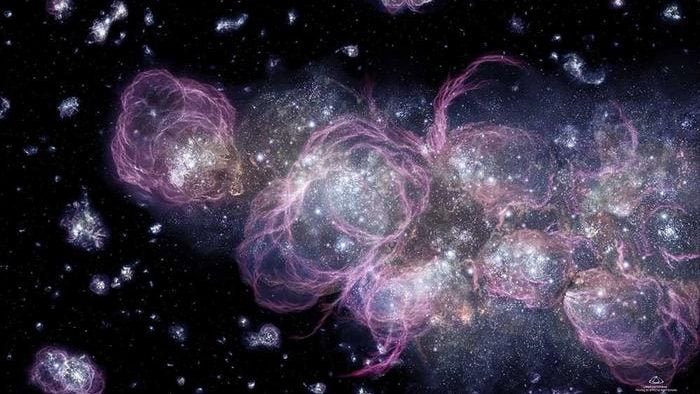
Webb, launched in 2021, has spent its first years turning up young galaxies that refuse to behave. It “opened up a whole bunch of new questions about the evolution of these early galaxies,” says Grace Telford, an assistant professor of physics and astronomy at the University of Utah who led the work, and her verdict on the galaxies themselves is blunter still: they’re weird.
Stars above about 20 times the Sun’s mass spend their short main-sequence lives as O-type stars, so hot that much of their output lands in the extreme ultraviolet, where it can strip electrons from hydrogen (the same process that, early in cosmic history, reionized the gas between galaxies). Astronomers lump every element heavier than hydrogen and helium together as metals, and the first galaxies had precious little of them. The Milky Way, replete with the stuff, makes a poor stand-in. So the survey, the Treasury of Extremely Metal-Poor O Stars (TEMPOS), went looking in the next best places, six dwarf galaxies within about 5 million light-years, each with metal abundances below 20 percent of the Sun’s.

Faint Stars, Expensive Hubble Hours
The catch is distance. Individual stars that far off are so faint that each one eats into Hubble’s schedule, and Telford does the sums plainly: “It’s a sample of 29 stars, which doesn’t sound like a lot, but when each one costs up to 35 hours of Hubble time to observe, it gets really expensive.”
The survey added fresh far-ultraviolet spectra of 12 stars to archival observations of 17 more, then reduced all 29 the same way so they could be compared like for like. Before it, only 11 O stars in galaxies this metal-poor had wind speeds from detailed modeling, too few to span the range of temperatures and life stages. The new set covers most of the O-star types these small galaxies are known to hold, with gaps where no suitable star has turned up (early-type supergiants in the poorest galaxies, for one).
Where the Winds Begin to Falter
The measurement at the heart of it is the terminal wind speed, roughly the top velocity gas reaches as it streams away, read off how far a carbon absorption line smears toward the blue. Across the sample it falls as metallicity falls, much as radiation-driven wind theory expects, but in the three poorest galaxies it seems to fall harder: “There’s sort of a smooth trend and then suddenly for lowest-metallicity stars, the wind speed really drops off,” Telford says, and she admits she was “so excited to find that fun surprise in the data.”
Some of the contrasts are stark. Two giants of the same spectral class, one in a comparatively metal-rich dwarf galaxy and one in Sextans A, show wind absorption that differs in reach by more than 600 kilometers per second, and the Sextans A star lacks the telltale emission bump altogether. Several stars in the poorest galaxies show no visible wind at all, with apparent speeds under about 400 kilometers per second, while the fastest winds in the survey top 2,000 kilometers per second, quick enough to cross the continental United States in a little over two seconds.
Set alongside 43 O stars in the Small Magellanic Cloud and 47 in the Large, measured the same way from earlier Hubble spectra, the survey’s merely metal-poor stars slot onto a fairly smooth downward slope; the extremely metal-poor ones sit below it. The iron tells a parallel story, since at a given spectral type the stars in the less impoverished galaxies absorb noticeably more ultraviolet light in dense thickets of iron lines, a hint that the sample spans a real spread in iron, the element thought to do much of the work of launching these winds.
Tentative is the authors’ own word for the steep fall, and not a courtesy. The poorest group holds just 15 stars, their metallicities are borrowed from older supergiants in the same galaxies rather than measured in the O stars themselves, and the empirical wind speeds run about 15 percent high against a model-based method.
Nor is speed the same thing as mass lost, which is what decides how much of a star is left by the end. Pinning that down needs full atmosphere models fitted to the ultraviolet spectra and to visible-light spectra from the Keck Observatory in Hawaii, work the team has under way.
If the drop holds up, the consequences could run a long way outward. Stars that shed less of themselves would keep more mass for later, which could change how they evolve, how they die and how much ionizing light they pour into their surroundings, and those are exactly the ingredients baked into the population models used to interpret Webb’s galaxies. There’s a stranger thread in the data too, as eight of the 29 stars move oddly for their place in their galaxy’s rotation, making them candidate runaways, possibly kicked loose by a companion’s supernova or a close encounter in a crowded cluster. Nobody yet knows how common such partnerships are at these metallicities.
The processed spectra are going public through the Mikulski Archive for Space Telescopes, so anyone can check the fall-off for themselves. With a handful of stars, Telford notes, “you don’t see these trends,” and with 29 you start to; whether the winds of the universe’s first massive stars were feebler still is the question the next round of modeling gets to chew on.
Reference
Telford, O. G., Erba, C., McQuinn, K. B. W., Hawcroft, C., Sander, A. A. C., Roman-Duval, J., Chisholm, J., Berg, D. A., Ramachandran, V., Zheng, Y., Leitherer, C., Mintz, A., & Kirby, E. N. (2026). The Treasury of Extremely Metal-poor O Stars. The Astrophysical Journal Supplement Series, 286(2), 50. https://doi.org/10.3847/1538-4365/ae95f6
- Study type: Observational spectroscopic survey and first data release (Hubble Space Telescope Treasury program); peer-reviewed, published in The Astrophysical Journal Supplement Series, open access.
- Sample size: 29 O-type stars in six nearby dwarf galaxies (12 newly observed, 17 from archival spectra); 15 in the extremely metal-poor group below about 10% solar.
- Instrument: Hubble’s Cosmic Origins Spectrograph, far-ultraviolet gratings G130M plus G160M or G140L, coadded and binned uniformly.
- Comparison group: 43 Small Magellanic Cloud and 47 Large Magellanic Cloud O stars with wind speeds measured the same way from the ULLYSES Hubble program (20–50% solar).
- Period covered: New observations December 2023 to February 2026, combined with archival spectra from earlier Hubble programs.
- Funding / conflicts of interest: NASA through Space Telescope Science Institute grants; Carnegie-Princeton Fellowship; German Research Foundation. Competing interests: not reported. Several authors work at the institute that operates Hubble.
- Data availability: Coadded spectra public through the Mikulski Archive for Space Telescopes (doi:10.17909/fcda-fn73); optical spectra and photometry to follow.
- Main limitation: The steeper decline is tentative: it rests on 15 stars whose metallicities come from host-galaxy supergiants, not the O stars, and blue-edge wind speeds run about 15% above model-based values.
FAQ
Why does the speed of a star’s wind matter to astronomers?
The speed of a massive star’s wind matters because it is one of the clearest signs of how strongly the star drives material off its surface. Mass lost that way can shape how the star evolves, how it dies and how much ionizing light it pours into its surroundings, and those same ingredients feed the models astronomers use to interpret the light of distant galaxies.
Why study stars in nearby dwarf galaxies instead of the early galaxies themselves?
Astronomers study stars in nearby dwarf galaxies because those dwarfs are poor in metals in much the way the first galaxies were, and they sit within about 5 million light-years, close enough for Hubble to take spectra of individual stars. The Milky Way, rich in metals, makes a poor stand-in. Even so, the stars are faint enough that a single one can cost up to 35 hours of Hubble time.
Is it true that stars with fewer metals always drive weaker winds?
It is broadly true that massive stars with fewer metals drive weaker winds, and this survey saw wind speeds fall as metallicity fell across its 29 stars. What remains unsettled is a hint that the drop turns much steeper below about 10 percent of the Sun’s metallicity. The authors call that result tentative, because it rests on 15 stars whose metallicities are borrowed from their host galaxies rather than measured in the stars.
Could weaker winds change how astronomers read Webb’s early galaxies?
Weaker winds could change how astronomers read Webb’s early galaxies, because stars that shed less mass would keep more of it, which could alter how they evolve, how they die and how much ionizing light they produce. Those are exactly the ingredients in the population models used to interpret distant galaxies, and the models take much of their stellar physics from metal-rich stars. Whether the steep drop is real still has to be tested with full atmosphere models.
Why would some of these giant stars be moving oddly within their galaxies?
Some of these giant stars may be moving oddly within their galaxies because they were kicked loose, possibly by a companion’s supernova or a close encounter in a crowded cluster. Eight of the 29 stars move in ways their galaxy’s rotation does not explain, making them candidate runaways. Nobody yet knows how common such stellar partnerships are at these low metallicities.


Cite This Page