
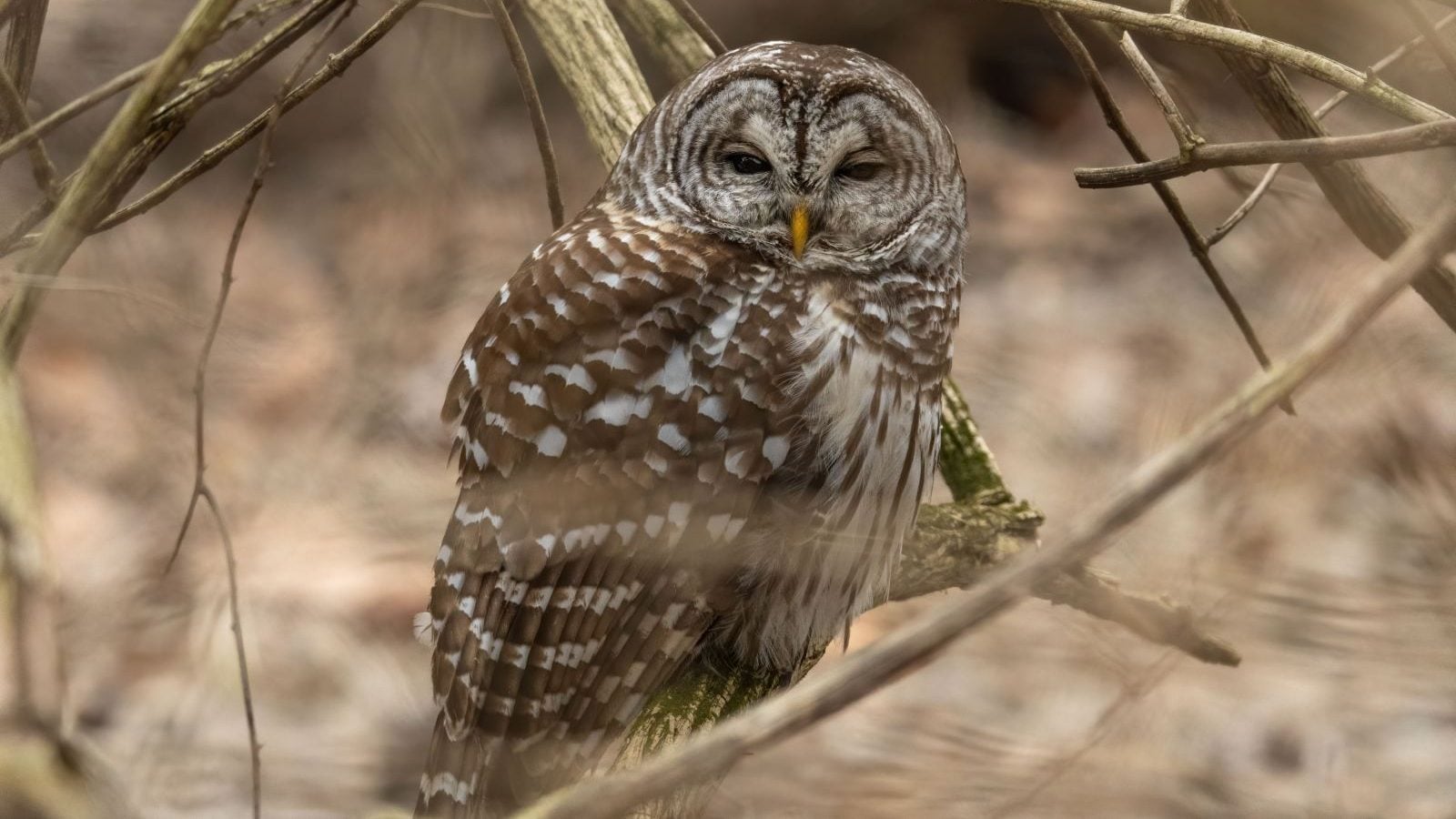
What the Study Found
- GPS tags on 56 barred owls across 4,070 square kilometers of northwestern California showed consistent selection for an old-forest gradient: high canopy cover, tall stands, large trees, diverse tree sizes, and old dominant age.
- The average barred owl home range covered 6.7 square kilometers, about 28 times the home range the same research team measured for barred owls in their native Louisiana range.
- On average, 64 percent of a barred owl’s home range overlapped mapped northern spotted owl habitat, and 38 percent was the highest-quality nesting and roosting forest, the single largest habitat class inside the home range.
- Barred owls used mapped spotted owl habitat about 30 percent more intensively than non-habitat, and use rose with nesting and roosting suitability, reaching about 52 percent above baseline in highly suitable forest.
- Scaling from 1,171 removed owls, the study estimates that removals of established males freed about 1,873 square kilometers of spotted owl habitat, including 1,149 square kilometers of highly suitable nesting and roosting forest, though the unique footprint was closer to 1,851 square kilometers because effort clustered and owls recolonized.
The work begins with a net that can rise ten meters into the trees. After local sunset, field crews broadcast barred owl calls across steep Klamath and Coast Range forest, wait for a territorial bird to answer, and fit the captured owl with a backpack harness carrying a GPS tag of about 20 grams. The tag is programmed to record one fix every four hours for 61 days. Then the schedule ends, and the same coordinated regional program that supplied the tracking data usually removes the tagged owl. In this study, measurement and management were never separate for long.
That pairing matters because barred owls are no longer a rumor at the edge of the northern spotted owl’s range. Native to eastern North America, they spread west during the twentieth century and now occupy forest across Washington, Oregon, and California. A 2019 synthesis concluded that barred owls exert an “overwhelmingly negative influence” on spotted owls where the species co-occur, a review for managers warned. What remained unresolved was spatial: not whether barred owls hurt spotted owls, but exactly which trees each invader chooses, and how much ground one bird effectively takes out of circulation.
The Tags Turned a Hunch Into a Map
Earlier radio telemetry could follow only coarse fixes, and acoustic monitoring can say a barred owl is present without saying what it uses. High-resolution GPS changed the evidentiary scale across animal ecology by tying movement to remotely mapped habitat, a 2015 Science review noted, and this study puts that capacity inside old-growth structure. The team analyzed 56 owls that met a ten-day minimum, after two of 58 tagged birds dropped out, and the cleaned tracks averaged 294.7 locations per owl across a mean of 56 days. Six stationary calibration tags, including one placed inside a tree cavity to mimic signal conditions for cavity-nesting owls, measured mean horizontal error at 47.2 meters, large enough that the researchers modeled it explicitly rather than pretending the forest floor was a clean grid.

The habitat layers underneath those tracks were built from gradient nearest neighbor maps and spotted owl models long used in Northwest Forest Plan monitoring. The owls did not spread evenly across the options. Their use loaded onto one principal gradient the authors call an old-forest axis, a composite of canopy cover, diameter diversity, stand height, large-conifer density, mean tree diameter, and dominant stand age. Six of those nine structural variables were positive with confidence intervals excluding zero. The dead-wood measures, snag biomass and down wood, pointed the same way but were weaker, and topographic wetness showed no selection at all in this dissected terrain.
The result is not simply that barred owls like big trees. It is that they concentrate where the old-forest community is richest. The same attributes that define late-seral forest also support flying squirrels, tree voles, fishers, Humboldt martens, marbled murrelets, amphibians, and the spotted owl itself. Globally, invasive predators are implicated in 87 bird, 45 mammal, and 10 reptile extinctions, 58 percent of recent extinctions in those groups, a 2016 meta-analysis found, and alien species are the most common threat associated with vertebrate extinctions overall in a companion Red List analysis. The California case is a local version of that larger pattern, sharpened by the fact that the invader is selecting the very structure conservation maps were built to protect.
Selection Peaked Where Spotted Owls Nest
The spotted owl layers made the overlap legible. Barred owls selected mapped spotted owl habitat with an intensity ratio of 1.30, meaning about 30 percent heavier use than non-habitat. Across the four nesting and roosting classes, selection climbed from unsuitable to marginal to suitable to highly suitable forest, where the intensity ratio reached 1.52. Inside an average 6.7-square-kilometer home range sat 3.83 square kilometers of spotted owl habitat and 2.35 square kilometers of highly suitable nesting and roosting forest. Sixty-four percent of the typical territory was spotted owl habitat on paper. Thirty-eight percent was the best of it.
“Every stand of that forest still shows up as spotted owl habitat on our maps,” said Dr. Vitek Jirinec, research scientist at Integral Ecology Research Center and lead author of the study. “But habitat isn’t just trees, it’s trees a spotted owl can actually live in, and barred owls have taken that off the table across much of the landscape. Managing the invader is proving just as critical as protecting the trees themselves.”
The quote draws the study’s central line: structure is necessary, but occupancy is the test. Under the ecological definition the authors use, habitat is the set of resources and conditions that produce occupancy. A barred owl does not have to cut a tree down to subtract the stand from a spotted owl’s usable world. It only has to hold the territory, hunt the shared prey, and dominate the encounter. That is functional habitat loss, a biotic subtraction that a vegetation layer cannot register.
The per-bird footprint makes the subtraction expensive. The same continuous-time movement framework that produced a 6.7-square-kilometer mean in California produced 0.24 square kilometers for barred owls in Louisiana, so each invader here commands roughly 28 times the space it would at home. The comparison is unusually clean because both estimates come from the same analytical approach. It also turns removal math into habitat math. If one resident pair vacates a territory, the forest structure is still standing, and the study estimates that several square kilometers can function again for spotted owls.
Removal Works Like Reopening, Not Like Banking
That hopeful arithmetic already has a policy frame around it. In 2024 the U.S. Fish and Wildlife Service finalized a barred owl management strategy after considering non-lethal alternatives, calling lethal removal in identified management areas the only population reduction method proven to work for reducing barred owls and improving spotted owl populations. The new paper supplies a finer-grained reason such a strategy can reclaim habitat: because barred owls select the same high-quality stands, taking out established birds is not a random subtraction from the landscape. It is targeted release of the most contested forest.
The estimate is deliberately conservative. Of 1,171 barred owls removed during the study interval, the authors scaled habitat release only from the 489 removed males old enough to be likely territorial residents, even though females and younger birds may also reduce pressure. Multiplying by the mean habitat inside a home range yields 1,873 square kilometers of spotted owl habitat made available, with 628 square kilometers marginal, 621 suitable, and 1,149 highly suitable nesting and roosting forest. But removals were clustered and recolonization is quick, so the team also drew equal-area circles around removal sites and dissolved the overlaps. The unique footprint came to 1,851 square kilometers, about 57 percent of the naive additive total. Gains are real, but they are not banked forever; they have to be maintained.
That maintenance problem is the caveat that changes the story. This is not a study in which protecting acreage finishes the job. It suggests a specialist can become conservation-reliant, dependent on continued control of the competitor even inside intact forest. The mechanism could also reach past the owl-owl contest. Barred owls are generalist predators whose diets include salamanders, reptiles, small carnivores, and the small mammals that move fungal spores and nutrients through old forest. Concentrated predation by a new apex consumer is exactly the sort of perturbation the trophic-cascade literature warns can propagate beyond the target species. The study does not measure those cascades. Its habitat results point where to look.
“Spotted owls are the reason this study exists, but they’re part of a much larger old-growth food web, one where every species plays a role in keeping the system intact,” said Dr. Greta Wengert, Co-Founder and Co-Director of IERC and principal investigator on the study. “This means protection of the old-growth biological community requires staying committed to managing this invader for the long haul. This is exactly the kind of science IERC specializes in: rigorous enough for a peer-reviewed journal, specific enough for a manager to rely on for years to come.”
The limit is built into the same data that make the finding precise. GPS locations and derived home-range polygons are not public because they contain sensitive spatial information and could enable inference about illicit trespass cannabis cultivation sites, posing risks to conservation and enforcement work. The forest that made the signal legible also made the raw map dangerous to publish. Summary data sit in the supplement, and de-identified data may move under request and agreement, but the exact tracks stay guarded. For a study about what an invader can find in old growth, that is a fitting edge: even the evidence has to be kept from becoming a map for the wrong kind of use.
- Study Type: Peer-reviewed observational GPS-telemetry and resource-selection study with management-removal scaling; published August 7, 2026, in Biological Conservation, volume 322, article 112035 (open access); DOI 10.1016/j.biocon.2026.112035
- Sample: 58 barred owls GPS-tagged in northwestern California, 56 retained for analysis after a ten-day minimum tracking threshold; 1,171 barred owls removed in the same regional program during the study interval; analyses scaled from 489 removed males beyond the first molt cycle
- Models Used: Continuous-time movement models in ctmm; autocorrelated kernel density estimates for 95 percent home ranges with calibrated GPS error; resource selection functions comparing used locations with availability inside each home range; principal-component old-forest axis from nine collinear structural variables; hierarchical meta-analytic population estimates; weighted logistic mixed models as a robustness check; MCP, fixed KDE, and LoCoH estimates only for comparison
- Manipulation: No experimental habitat manipulation; live capture, tagging, and tracking ran alongside a permitted barred owl removal program, with capture and removal crews coordinated to avoid active telemetry subjects
- Duration: Field work from August 14, 2023 to August 29, 2025, across 4,070 square kilometers; tags programmed for 61 days, with analyzed owls tracked a mean of 56.0 days and contributing a mean of 294.7 filtered locations
- Funding / Conflicts of Interest: Funded primarily by the California Department of Fish and Wildlife’s Cannabis Restoration Grant Program (Q2291211), with support acknowledged from USDA APHIS Wildlife Services; J. Mark Higley reports a funding relationship with the Hoopa Valley Tribe and M. Zachariah Peery reports a funding relationship with the University of Wisconsin-Madison; other authors declared no known competing financial interests or personal relationships
- Data Availability: LEMMA GNN layers and northern spotted owl habitat and nesting-roosting layers are public and updated annually through the NWFP NSO mapping portal; barred owl GPS telemetry locations and derived home-range polygons are not public because they could reveal sensitive sites tied to illicit trespass cannabis cultivation; summary data are in the supplement and de-identified data may be shared by request under approval and a data-use agreement
- Main Limitation: Inference depends on modeled forest-structure and spotted owl habitat layers; GPS error averaged 47.2 meters and likely made selection estimates conservative because dense canopy and steep drainages both degrade fixes and characterize selected forest; structural predictors were too collinear to interpret as independent effects; habitat-release estimates are not spatially additive and require sustained control because barred owls recolonize
Reference
Jirinec, V., Gabriel, M. W., Higley, J. M., Davis, R. J., Tenberge, J. E., Varian, C. P., Hofstadter, D. F., Peery, M. Z., Jenkins, J. M. A., Franklin, A. B., & Wengert, G. M. (2026). Invasive barred owls select old-forest structure: Functional habitat loss for spotted owls and a threat to old-forest fauna. Biological Conservation, 322, 112035. https://doi.org/10.1016/j.biocon.2026.112035
FAQ
Did the study prove barred owls cause spotted owl declines?
Not by itself, and it does not need to. Removal experiments and range-wide demographic work had already linked barred owls to depressed spotted owl survival, reproduction, and occupancy. This study resolves the spatial mechanism underneath that competition: barred owls select the same old-forest structure spotted owls need, especially the highest-quality nesting and roosting forest, and each bird holds a large territory.
What does “functional habitat loss” mean here?
It means a stand can remain old, tall, dense, and mapped as suitable while failing the ecological test for the species. If barred owls prevent spotted owls from occupying that stand, the trees are present but the habitat is not functioning for occupancy. A structure-based map can still call it habitat, which is why the authors argue that protecting structure is necessary but not sufficient.
Why are California home ranges so much larger than Louisiana home ranges?
The paper’s estimate is about 28 times larger in the invaded range, using the same movement framework in both places. The authors interpret the gap as consistent with resources thinning toward higher latitudes, which forces each owl to hold more ground. The practical consequence is that one invader exerts competitive and predatory pressure over several square kilometers of old forest rather than a fraction of one.
Does removing barred owls permanently restore spotted owl habitat?
No. Removing a resident pair can reopen several square kilometers because the forest structure remains, but barred owls recolonize and removal effort clusters in the same places over years. That is why the additive estimate of 1,873 square kilometers of spotted owl habitat freed up comes with a separate unique-footprint estimate of about 1,851 square kilometers, and why the authors frame recovery as sustained management rather than a one-time fix.
Is this only about spotted owls?
The mapped evidence is about spotted owls because their habitat layers are the mature management tools in this system. But the attributes barred owls selected also define habitat for a wider old-forest community, and barred owls eat a broader diet than spotted owls, including amphibians, reptiles, and small carnivores. The study points to likely pressure beyond the owl-owl contest while leaving those food-web effects for direct tests.


Cite This Page