What We Know
- Sandia says the second Mobile Guardian Transporter prototype underwent a full-scale, head-on barrier crash at its rocket sled track in autumn 2025.
- The event completed a series that began with a 2020 side-impact test of the first prototype.
- Sandia says the test carried mock nuclear-weapon hardware and collected data on the trailer, restraints and shipping containers to support design qualification.
- Public accounts do not disclose the impact speed, damage findings, acceptance criteria, safety margins or production schedule.
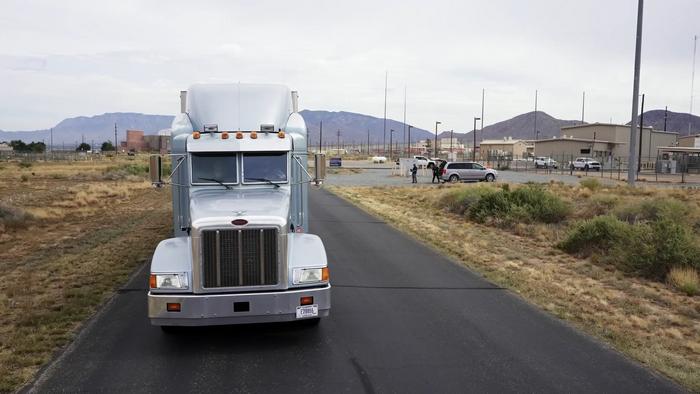
Rockets sent a semitrailer loaded with mock nuclear weapons down a track at Sandia National Laboratories in New Mexico and into a barrier. The collision was over in moments, but Sandia says it completed the final full-scale crash test of the Mobile Guardian Transporter, a proposed new system for moving nuclear weapons and other sensitive material for the US Department of Energy.
The headline result is not a dramatic survival claim. It’s a dataset. Sandia says engineers instrumented the trailer with nearly 500 channels measuring acceleration, strain, force and temperature, alongside roughly three dozen cameras. They are now comparing those measurements with predictions from computer models that could later be used to examine a wider range of crash environments.
A Test Built Around the Data
The Mobile Guardian Transporter is intended for the National Nuclear Security Administration’s Office of Secure Transportation, which has moved nuclear weapons, weapons components and special nuclear materials since 1947. The office says it has accumulated more than 140 million miles of over-the-road experience since its establishment in 1975 without an accident causing a fatality or release of radioactive material. That history makes the threshold for a replacement vehicle unusually high.

Sandia has disclosed few technical details about the trailer itself. Its release says that the crash pushed the trailer, cargo restraints and shipping containers to their limits, but does not state the impact speed, the forces recorded, the degree of damage or the criteria by which the vehicle will ultimately be accepted. Sandia says it met its testing objectives, but that is not the same as a publicly available safety case or an operational qualification.
The test is the second in a series. In 2020, Sandia used rockets to propel a semitractor-trailer at highway speeds into the side of the first Mobile Guardian prototype. It said then that the data would support qualification and help it understand cargo response in accident scenarios. The earlier test was a side impact; this one was a head-on collision with a barrier.
Why a Rocket Sled?
Rocket sleds allow engineers to create a controlled, repeatable high-energy impact while packing a test article with sensors that would be difficult to use in an uncontrolled road crash. Sandia says its 10,000-foot Rocket Sled Track can support high-velocity impact, acceleration and other testing, with telemetry, hardened recorders, high-speed imaging and data-acquisition systems capable of sampling at up to 1 MHz. The facility is designed to maximize the measurements recovered from a destructive test.
That distinction matters because a full-scale crash consumes a prototype. Sandia says it built redundancy into its data paths in case individual instruments failed, and describes the effort as the largest data collection campaign in the track facility’s history. A temporary multi-acre test operation, including control and data-collection trailers, was assembled near the track for the 2025 event.
The eventual objective is not to recreate every conceivable collision with a real transporter. It is to establish whether simulations reproduce the critical behaviour seen in a carefully measured crash, then use those validated models to explore other accident conditions. Sandia says the model will become an enduring assessment tool for trailer performance, weapon-system safety during transport and nuclear safety of the trailer.
Qualification Is Still Ahead
That puts the announcement at an important but bounded point in the program. A crash test can show how a particular prototype and representative cargo configuration behaved under a particular set of conditions. Model validation is what determines how much engineers can infer beyond that one event. Sandia says analysis is under way, and that the results will inform final design decisions before production can begin.
The project also sits within a much wider nuclear-enterprise task. The Office of Secure Transportation moves material among sites involved in manufacturing, maintenance, surveillance and dismantlement, and its public account stresses that safety and security are inseparable parts of the mission. That makes the transporter a logistics system as well as a vehicle.
About 200 Sandia staff worked on the crash test, according to the laboratory, alongside partners from the Office of Secure Transportation, NNSA, Los Alamos National Laboratory and Lawrence Livermore National Laboratory. The Kansas City National Security Campus’s New Mexico Operations location is named as the production agency. Yet the public record still leaves the central engineering question unanswered: whether the measurements support the model and requirements package needed to move from prototype testing to a production fleet.
FAQ
What is the Mobile Guardian Transporter?
It is a next-generation semitrailer transport system being developed for NNSA’s Office of Secure Transportation, the federal organization responsible for moving nuclear weapons, components and special nuclear materials. Sandia says the vehicle is intended to carry nuclear weapons and other sensitive material, but the publicly released description does not detail its protective systems or operating procedures.
What does design qualification mean here?
Qualification is the process of assembling evidence that a design meets its defined requirements. In this case, Sandia says crash-test measurements will be compared with pre-test simulations and used to refine models. The announced test is an input to that process, not public proof that the transporter has completed all approvals or entered service.
Why use mock nuclear weapons?
Representative mock hardware lets engineers measure how the trailer, restraints and shipping containers respond under severe mechanical loading without moving live nuclear weapons through a destructive test. Sandia says several weapons modernization and stockpile programs provided hardware because different weapon types can have different transportation requirements.
Does the test show the system is safe in every crash?
No. It provides measurements from one full-scale test configuration. Sandia says those data will be used to validate models for other crash environments, but it has not released the underlying measurements, detailed results, acceptance thresholds or the range of conditions the final models will cover.
Why does this matter for nuclear deterrence?
A nuclear stockpile depends on physical movement of weapons, components and materials between authorized sites for activities such as maintenance, modernization and dismantlement. Secure transport is therefore a supporting capability for the broader nuclear-weapons enterprise, even though the details of individual shipments are not public.


Cite This Page