
What the Study Found
- A global Q-survey of 31 GIAHS community members identified four distinct categories of agricultural heritage systems.
- The four types center on product certification, national staple foods, global exports, and cultural identity plus climate adaptation.
- GIAHS designation was valued most for raising awareness, boosting local pride, and driving heritage-preservation policies
- Land abandonment, aging farmers, and climate change were the shared threats named across nearly all sites
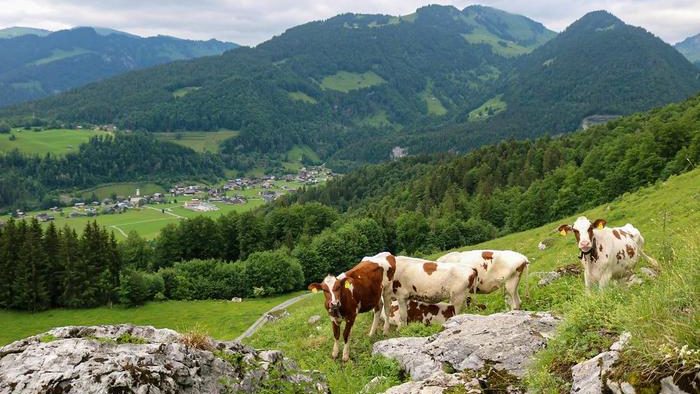
On a slope in the Austrian Alps, cows are doing something their ancestors did centuries ago. They graze on grasslands that have been grazed, in much the same way, for generations, and in doing so they keep alive a meadow thick with wildflowers and the milk that becomes hay-milk cheese. No fertiliser tankers. No reseeding. Just animals, grass, and a rhythm that nobody had to invent.
It looks, at first glance, like a postcard from the past. But a team of researchers reckons these places might be one of the more useful things we have for the future.
The Alpine pastures are one of more than a hundred sites that the UN’s Food and Agriculture Organization has badged as Globally Important Agricultural Heritage Systems, or GIAHS (a clunky acronym, sorry, but you’ll see it a lot). The idea, born out of the 2002 World Summit on Sustainable Development, is to recognise landscapes where people have farmed in step with their environment for so long that the farming and the nature have grown into each other. The first eight were designated in 2008. By 2025 there were 102 of them, scattered across 29 countries, from terraced rice fields in the Philippines to date-palm oases watered by irrigation channels older than most nation states.

And yet, for all that recognition, nobody knew much about what actually keeps these systems going. What makes an ancient farming landscape survive into the present, rather than emptying out?
That was the question Maria Chiara Camporese, a PhD researcher at the University of Göttingen, set out to answer with her colleagues. Rather than parachute into one site and study it to death, they cast a wide net: a survey sent to roughly 350 experts, managers and farmers across the GIAHS world, asking them to sort 34 statements about their landscapes from most to least relevant. Thirty-one people responded, covering 22 sites in 13 countries. A modest haul, perhaps, but Q-methodology (the rather niche technique they used) is built to squeeze patterns of opinion out of small, opinionated groups.
“Our analysis of Globally Important Agricultural Heritage Systems shows that food production and nature conservation do not have to be in opposition,” says Camporese. That single sentence is doing a lot of work, because the assumption it pushes against, that you either grow food or you protect wildlife, sits underneath an awful lot of land-use policy.
Four Ways to Stay Alive
The responses sorted themselves into four loose camps. Some sites lean on certification, slapping a geographic-indication or organic label on their produce so that an olive oil or a cheese fetches a price that reflects the work behind it. Others are built around staple foods grown for the nation’s own table through short, local supply chains, the kind of place where women select the seeds and a recipe might still call for a wild plant gathered from the hillside. A third group exports renowned specialities to the world; the tea-grass system in Shizuoka, Japan, where farmers cut grass to mulch their tea bushes, is the sort of thing that pulls in visitors and revenue alike. And a fourth camp holds on, above all, to culture: the festivals, the rituals, the shared habit of giving away your surplus harvest to a neighbour whose yield fell short.
What threads through all four is that none of them treats conservation as a separate activity bolted onto farming. The biodiversity is a by-product of how the food gets made. Keep the farming, you keep the meadow.
Designation helps, the respondents said, though not always in the ways you might expect. The clearest win was pride and visibility: being named on a global list makes a place legible to tourists, to policymakers, to the next generation deciding whether to stay. One respondent described family farming and traditional food culture as fundamental to what their site is. Another said that once their area was certified, the events and tours that followed breathed life back into the local economy. The recognition, in other words, can pay rent.
The Trouble With Postcards
Here’s the catch, and it’s a big one. These landscapes are ageing, in every sense. The farmers are getting older, the young are leaving for cities, fields are being abandoned, and the climate that these systems co-evolved with is shifting underneath them. Altered rainfall, droughts, soil degradation: the very stability that made a heritage system a heritage system is no longer guaranteed. Camporese and her colleagues are blunt that there is no single fix. What works for a Japanese tea hillside won’t transplant to an Andean quinoa terrace or a Portuguese rye field.
There’s a sharper worry lurking too. Lean too hard on tourism and the labelling that comes with it, and a working farm can curdle into a sort of living museum, prettier than it is productive, its agriculture hollowed out to please the people photographing it. The researchers note this tension rather than waving it away.
Still, the deeper point survives the caveats. “Our study highlights that traditional farming landscapes can offer practical examples of how land can be used sustainably while also protecting cultural heritage and supporting local livelihoods,” says Camporese. The systems are not relics to be sealed under glass; they are working demonstrations, imperfect and under pressure, of a balance that the rest of agriculture keeps insisting is impossible.
Which raises an awkward question for everyone else. If a few hundred farmers in the Alps and the Andes and the rice terraces of Asia have been reconciling food and nature for centuries, what exactly is the rest of the world’s industrial farmland getting wrong? The map of these sites still has gaping holes, almost nothing in sub-Saharan Africa or Eastern Europe, and that absence is itself a clue about whose knowledge gets noticed. The next move may be less about discovering new lessons than about finally bothering to learn the ones already on the ground.
- Study type: Q-methodology survey (mixed quantitative-qualitative); peer-reviewed, published in Ecology and Society(2026)
- Intervention / focus: Classifying key attributes, designation impacts, and challenges of Globally Important Agricultural Heritage Systems (GIAHS) as an integrated landscape approach
- Method detail: 34-statement Q-sort (forced semi-normal distribution, ±4 scale) plus three open-ended questions; analyzed via PCA with varimax rotation (four-factor solution) using the R “qmethod” package
- Comparator: No experimental control; four emergent factor-categories contrasted against each other and against integrated landscape approach frameworks
- Sample size: 31 respondents (from ~350 invited via snowball sampling), covering 22 GIAHS sites across 13 countries; mostly researchers (13), with managers, consultants, association staff, and 3 farmers
- Duration: ~30-minute survey; fieldwork tied to the 2024 ERAHS conference in Gifu, Japan
- Funding / conflicts of interest: Funded by the German Research Foundation (DFG) via Biodiversa+ and the FAO; no conflicts of interest disclosed. AI tools used only for proofreading
- Main limitation: Researcher-heavy sample (few farmers) may dampen on-the-ground diversity of views; English/French-only online survey excluded low-connectivity actors and left sub-Saharan Africa, the Middle East, and parts of South Asia unrepresented
- Readiness / evidence level: Exploratory, perspective-mapping study—surfaces viewpoint patterns rather than causal or representative findings; not generalizable to all GIAHS communities
Reference
Camporese, M. C., M. Jay, M. Nishi, and T. Plieninger. 2026. Exploring the role of Globally Important Agricultural Heritage Systems in integrated landscape approaches. Ecology and Society 31(2):3. https://doi.org/10.5751/ES-17116-310203
Frequently Asked Questions
What exactly is a Globally Important Agricultural Heritage System?
It’s a designation from the UN’s Food and Agriculture Organization for landscapes where traditional farming has sustained both food production and rich biodiversity over long stretches of time. Think terraced rice fields, date-palm oases, or Alpine grazing pastures. By 2025 there were 102 such sites across 29 countries.
Why does this matter if it only covers a hundred or so places?
Because these sites work as proof of concept. They show that producing food and protecting nature need not be rival goals, which challenges a core assumption in a lot of modern land-use planning. The lessons are meant to inform farming far beyond the designated sites themselves.
How did the researchers actually study this?
They used a Q-survey, a method that asks people to rank a set of statements to reveal patterns of shared opinion. Around 350 experts and farmers were contacted, and 31 responses covering 22 sites in 13 countries were analysed. From those rankings, four distinct types of heritage farming system emerged.
Is traditional farming actually under threat?
Yes. Aging farmers, young people moving to cities, land abandonment, and a changing climate all pile pressure on these systems. The study is clear that there is no one-size-fits-all rescue plan; each landscape needs an approach tuned to its own communities and conditions.


Cite This Page