
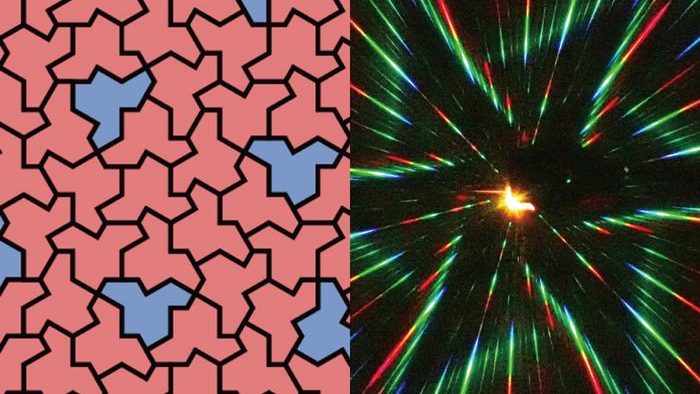
What the Study Found
- Laser light scattered from a nonrepeating tile pattern forms a pinwheel with no mirror symmetry.
- Diffraction peaks stayed in the same places wherever the beam landed on the sample, the mark of long-range quasicrystalline order.
- Left-handed and right-handed circularly polarized light scattered differently, an effect absent in mirror-symmetric quasicrystals.
- Structures built as mirror images reversed the pinwheel’s handedness, and the arms’ tilt tracks the golden ratio.
The patterned square on the chip is about 500 micrometers on a side, smaller than a grain of rice, and it holds 372,100 holes that never once settle into a repeating arrangement. When Yuto Moritake and his colleagues bounced a green laser off it, the light coming back landed on a white screen as a pinwheel. Dozens of bright spots, sweeping around a common center, every arm canted the same way. Its mirror image is a different picture, which is an odd thing for scattered light to be, given that the pattern doing the scattering was built out of copies of a single shape.
That shape is called the Smith hat, and it turned up in 2023 at the end of a hunt that had run for 50 years. The question behind the hunt sounds almost childish: can one tile, used over and over, cover a flat surface forever without the pattern ever repeating itself?
Mathematicians call this the einstein problem, from the German ein Stein, one stone. Nothing to do with Albert. Bathroom tiles fail the test immediately, since you can slide the pattern along by a fixed distance and land it right back on itself, whereas an aperiodic tiling never does that at any distance in any direction, and yet it is not disordered either: it keeps a long-range order that shows up as sharp bright spots whenever waves scatter off it. Roger Penrose found a pair of tiles with that property decades ago, and when Shechtman turned up real matter behaving the same way, crystallography had to rewrite its own definition of a crystal, a piece of housekeeping that eventually earned him a Nobel prize in chemistry in 2011.

A Dot in the Middle of Every Tile
Moritake’s group did not carve hat shapes into the chip at all. They dropped a single dot at the middle of every tile, threw the tiles away and kept the cloud of dots, which turned out to have a property the tiling itself lacks: rotate the whole cloud by one third of the way around and every dot lands exactly where another dot already was.
What the cloud has not got is a mirror line. Reflect it and you get something the original cannot be turned into, which is precisely the relationship between your left hand and your right, and physicists call that chirality. It is normally engineered one unit at a time, by seating some twisted little structure at every point of an otherwise ordinary lattice; here it falls out of the arrangement itself.
The odd part is where the arrangement comes from. “What is especially fascinating about the hat tile is that, although the resulting pattern appears irregular at first glance, it is actually constructed from the honeycomb lattice,” says Moritake, at the Institute of Industrial Science at the University of Tokyo. “We wanted to see whether this unique shape could also produce any unexpected physical phenomena.”
The Mirrored Copy Pinwheeled the Other Way
Making one is fiddly. An electron beam writes the pattern, then etching sinks the holes into a film of silicon nitride 350 nm thick, each hole 100 nm in radius and going the full depth of the layer. The team built structures at several spacings, from 600 to 750 nm between the points of the honeycomb frame underneath, and for each one they built its reflection as well, giving two samples to compare at every spacing. Light went in perpendicular to the surface and the reflected pattern was photographed off a white screen (the holder blocks the middle, so the center of every image is missing, which is the sort of detail that rarely survives into a press release). Under white light the pinwheel came out smeared into colors, the arms holding their angle while the spots shifted with wavelength; under the green laser at 532 nm it snapped into a dense field of sharp peaks.
Sharp peaks are the tell. A random scatter of holes gives a smear, whereas peaks mean long-range order, and these peaks stayed put no matter which part of the sample the beam landed on, which the authors read as evidence that the point cloud is quasicrystalline in the full sense. The reflected samples produced the reflected pinwheel, arms canted the other way. “We found that the diffraction patterns themselves become chiral because the structure lacks mirror symmetry,” says senior author Masaya Notomi. A numerical model, built by dropping an ideal point at each dot and taking its Fourier transform, put the peaks where the camera had found them, and the tilt of the pinwheel arms turns out to follow from the way each generation of tiles twists against the honeycomb underneath, in a ratio that creeps toward the square of the golden ratio.
Then the polarization test, which is where it gets properly strange. Circularly polarized light comes in two handednesses, and for an ordinary quasicrystal, one with a mirror line, both hands see the same thing and the diffraction is identical. Against the monotile pattern they’re not identical: some peaks brighten for one hand and dim for the other, and swapping a sample for its reflection swaps which peaks do what.
The peaks that respond to handedness are not the same peaks from one spacing to the next: the effect leans on the spacing and the diffraction angle as well as on the tiling, so it is not down to aperiodicity alone. The university’s release also has the pattern changing with the direction and the polarization of the incoming light, and the direction half of that is not in the paper, where every measurement was made with the beam perpendicular to the chip; what the paper reports is the opposite sort of independence, peak positions that don’t care where on the sample the light happens to land. Chirality here means only the absence of a mirror line within the plane of the chip, too, which the authors are careful to keep separate from handedness in three dimensions.
“This kind of optical response is fundamentally different from that observed in conventional quasicrystalline materials,” says Notomi. Whether it turns into anything is a different question, and the honest answer is that nobody knows yet: there is no device here, no efficiency figure, nothing benchmarked against the engineered chiral surfaces that already exist. What there is, perhaps, is a way to get a polarization-sensitive response out of the global arrangement of a structure rather than out of a clever repeating unit, which is a different lever, and levers of that sort tend to get pulled.
- Study type: Laboratory optics experiment (nanofabrication plus optical diffraction measurement) with a supporting Fourier-transform calculation; peer-reviewed, published open access in Nature Communications with a transparent peer review file
- Sample size: Two structure types, one the mirror image of the other, fabricated at pseudo-periods of 600–750 nm; the reported structure carries 372,100 etched holes across roughly 500 × 500 micrometers
- Structure examined: Points placed at the centers of the tiles of a Smith hat aperiodic monotile tiling, patterned as circular holes (100 nm radius, 350 nm deep) in a 350 nm silicon nitride film on a silicon substrate
- Measurement method: Normally incident laser light (supercontinuum white light, and a 532 nm laser diode), with the reflected diffraction pattern projected onto a white screen and photographed; polarization set with a polarizer and a waveplate
- Model: Diffraction calculated as the squared Fourier amplitude of delta functions placed on the point set, normalized at the origin of wavevector space; assumes ideal points rather than holes of finite size
- Funding / conflicts of interest: Japan Society for the Promotion of Science KAKENHI grants JP20H05641, JP21K14551, JP24K01377, JP24H02232 and JP24H00400; the authors declare no competing interests
- Data availability: Data supporting the figures and findings are deposited at Figshare, 10.6084/m9.figshare.29313743
- Main limitation: Author-stated: the circular polarization dependence varies with the pseudo-period and the diffraction angle, so it does not follow from the quasilattice alone. The chirality reported is the absence of a mirror line within the plane, not three-dimensional handedness
Reference
Moritake, Y., Takiguchi, M., Aihara, T., & Notomi, M. (2026). Chiral diffraction from aperiodic monotile structure. Nature Communications, 17(1). https://doi.org/10.1038/s41467-026-75023-7
Frequently Asked Questions
How can a pattern that never repeats still throw sharp dots of light?
A pattern that never repeats can still throw sharp dots of light because it is ordered without being periodic. The dots, called diffraction peaks, appear whenever the scattering points are arranged with long-range order, meaning the arrangement is predictable over large distances even though it never lands back on itself. A truly random scatter of holes would give a blur instead, which is why the sharp peaks in this experiment matter.
Why does it matter that the pattern has no mirror image?
It matters that the pattern has no mirror image because that missing mirror line, known as chirality, is what lets the structure treat left-handed and right-handed circularly polarized light differently. In an ordinary quasicrystal, which does have a mirror line, both handednesses scatter identically. Here some peaks brighten for one handedness and dim for the other, and building the mirror-image structure swaps the roles around.
What does the einstein problem have to do with Albert Einstein?
The einstein problem has nothing to do with Albert Einstein. The name comes from the German phrase ein Stein, meaning one stone, and it refers to the search for a single tile that can cover a flat surface forever without the pattern ever repeating. The Smith hat, found in 2023, was the shape that settled it.
Could this be used to control polarization in a real optical device?
This could conceivably be used to control polarization in a real optical device, but nothing in the work is a device yet. There is no efficiency figure and no benchmark against the engineered chiral surfaces already in use. What the experiment offers is a different route to a polarization-sensitive response, one that comes from the overall arrangement of the structure rather than from a repeating unit designed to be twisted.


Cite This Page