
What the Study Found
- Garmin and Samsung overestimated calories burned by roughly 69 and 57 kcal per session on average, versus about 22 kcal for Apple.
- Fitbit looked accurate only because implausible readings were excluded; counting them back in gives it the largest average error, about 129 kcal.
- Calorie errors grew larger as body fat percentage rose, across all four devices tested on 58 adults.
- Fitzpatrick skin type, from III to V, showed no measurable effect on accuracy, unlike the body fat differences the study did detect.
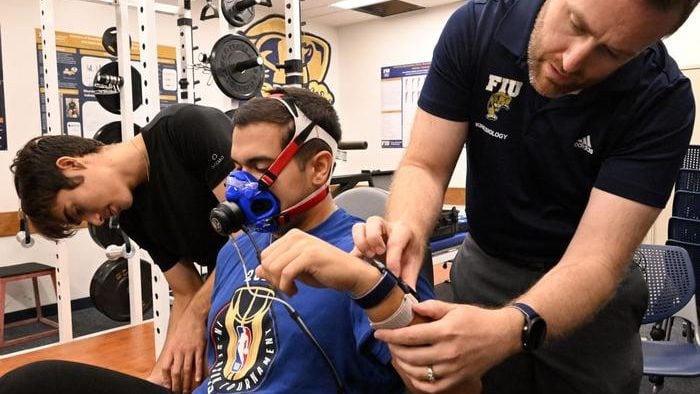
IT TOOK ten minutes of pedalling, a rubber mask, and four watches strapped to one wrist after another to expose what a decade of marketing had not. The gap between what a smartwatch claims you burned and what your body actually burned traces mainly to how each brand’s proprietary formula converts heart rate and motion into calories, tuned on leaner test populations, and has surprisingly little to do with the skin tone sensors are usually blamed for. A new trial out of Florida International University (FIU) put four of the most popular fitness trackers on the same wrists as a clinical grade metabolic analyzer and let the machines disagree. The disagreement was not small, and it was not evenly spread.
Wearables like these already sit on countless wrists, feeding decisions about how much to eat after a run or whether a diet is working. The same energy expenditure blind spot has turned up in other independent lab comparisons of popular trackers, even on devices that measured heart rate itself quite well. When the number on the screen overstates the real cost by dozens of kilocalories, the decision built on top of it is off too.
Under the strap, a smartwatch never actually measures a calorie. It watches a beam of light bounce off blood vessels near the skin, called photoplethysmography, and pairs the resulting heart rate signal with an accelerometer and a demographic based formula to guess at effort. That formula is proprietary, built somewhere you cannot see, and calibrated in ways companies do not have to disclose. When the wrist it is guessing about does not resemble the wrists in that calibration set, the guess drifts.

Researchers already suspected two obvious culprits for a bad guess: how dark a person’s skin is, since melanin can absorb some of the light the sensor relies on, and how much body fat sits between the sensor and the vessel it is trying to read. The Florida team set out to test both at once rather than assume which one mattered more.
Four Watches, Four Different Numbers
58 Hispanic adults with Fitzpatrick skin types III to V rode a recumbent bike through alternating stretches of moderate and vigorous effort while wearing an Apple Watch Series 8, a Fitbit Sense 2, a Samsung Galaxy Watch 5 and a Garmin Forerunner 955, all four at once. A COSMED K5 unit, the kind of equipment used in exercise physiology labs rather than living rooms, measured their real oxygen use breath by breath, the criterion every watch was judged against. Every watch overestimated calories burned on average, but not by equal amounts: Garmin’s bias worked out to roughly 69 kcal too many per session, Samsung’s to roughly 57, and Apple’s to a comparatively modest 22.
Jason Kostrna, the study’s lead author and an associate professor of kinesiology and exercise science at FIU, puts it thus: “You can’t treat the calories burned number it gives you as an accurate number, because it’s not.” The stakes are not abstract: “You could be hundreds of calories off each week and easily end up in a calorie surplus when you think you’re in a calorie deficit.”
The Body Fat Blind Spot
The pattern sharpened once the team looked at body fat percentage rather than the device alone. As body fat rose, every watch’s error grew with it, though not at the same rate: Garmin’s and Fitbit’s errors climbed fastest, while Apple’s stayed comparatively flat, an interaction the statistics called significant. One obvious suspect, ironically, turned out not to matter here: Fitzpatrick skin type, the classification the study was partly designed to test, showed no measurable effect on accuracy at all, a null result the press release covering this paper never mentions. Fitbit’s own numbers hide a complication. Averaged the ordinary way, its bias looked the smallest and least alarming of the four, but that average excluded seven sessions, about 13% of its trials, where the watch produced an implausible number, and putting those back in pushes Fitbit’s true mean overestimate to roughly 129 kcal, the worst of any device tested.
None of this makes a smartwatch useless for tracking effort. It means the calorie total on the screen behaves more like a ceiling than a receipt, especially for the people using it to manage their weight who also carry more body fat, the group the study found least well served.
The trial has limits of its own. It tested one exercise modality, a recumbent bike, and one population, Hispanic adults with medium to deep skin tones, so whether the same gaps show up on a run, or in a lighter skinned rider, is still an open question.
Kostrna doesn’t have a clean explanation for why body fat trips up the algorithms, but he has a guess: the formulas were likely built and tested on leaner volunteers, so a heavier body simply falls outside the range they were calibrated for. “When the companies are developing those algorithms, we don’t know where the test data is coming from,” he said. “That’s why I think it’s beneficial for the companies to see this type of data, so they can refine their products over time.”
He’s already running the follow-up: testing how the same four watches handle strength training instead of cycling.
Kostrna’s advice for now sits closer to a coping strategy than a fix: watch the trend line, not any single number, and let how you feel guide the day more than the total on your wrist. “Track your own trends over time,” he said. “If it becomes too much, don’t fixate on it.”
Reference
Kostrna, J., Oparina, E., Palacios, C., Rodriguez, A. J., Pei, J., Ajmal, A., & Ramella-Roman, J. C. (2026). Body fat, skin tone, and the accuracy of smartwatch caloric expenditure estimates. PLOS One, 21(7), e0353261. https://doi.org/10.1371/journal.pone.0353261
- Study type: Peer reviewed experimental validation study, published in PLOS One.
- Sample size: 58 Hispanic adults enrolled; analyzable device pairings ranged from 44 (Fitbit) to 52 (Apple) after data quality filtering.
- Intervention: Wrist worn readings from an Apple Watch Series 8, Fitbit Sense 2, Samsung Galaxy Watch 5 and Garmin Forerunner 955, worn simultaneously during a structured cycling bout.
- Comparator: A COSMED K5 indirect calorimetry system, the clinical grade criterion each watch’s estimate was measured against.
- Duration: Single lab session of about an hour, including a 10 minute cycling protocol with rest and recovery periods.
- Funding / conflicts of interest: NSF PATHS-UP pilot grant to the lead author; funder had no role in design, analysis or the decision to publish. Authors declare no competing interests.
- Data availability: Raw and cleaned data, analysis code and full model outputs are openly posted on OSF.
- Preregistration: Study procedures and analysis plan were preregistered on OSF prior to data collection.
- Main limitation: Tested one exercise modality (recumbent cycling) in one population (Hispanic adults with Fitzpatrick skin types III to V), which the authors say limits how far the results generalize to other activities and skin tones.
FAQ
Why do smartwatches overestimate calories burned in the first place?
Smartwatches overestimate calories burned because they never measure a calorie directly. They read heart rate through a light-based sensor and combine that with motion data and a proprietary formula built by each company, and that formula can drift from reality whenever the wearer’s body does not match the population the formula was calibrated on. Separate testing has found the heart rate half of that equation is comparatively more reliable than the calorie estimate it ultimately feeds.
Is one smartwatch brand more accurate than the others?
In this study, yes: Apple’s estimates ran closest to the lab’s true measurements, while Garmin and Samsung overestimated by the widest margins. Fitbit looked accurate on average only because a chunk of its implausible readings had been excluded from that average.
Does skin tone affect how accurate a smartwatch is?
Skin tone did not show a measurable effect on calorie accuracy in this trial, even though it was one of the two factors the researchers set out to test. That is a genuine null result, not an absence of evidence, though the small number of participants with the deepest skin tone tested here leaves some room for a future study to find something this one could not.
Should people with more body fat stop trusting their smartwatch’s calorie count?
They do not need to stop using it, but they should treat the number with more skepticism, since this study found errors grew specifically as body fat percentage rose. Using the calorie total as a rough ceiling rather than a precise figure, and watching trends over weeks rather than single sessions, is the more reliable approach the researchers themselves recommend, echoing the same weight management caution an earlier device comparison raised for anyone leaning on these numbers to manage their weight.
Could smartwatch calorie tracking get more accurate over time?
It could, if manufacturers adjust their algorithms using more diverse test data, which is one reason the lead researcher hopes companies pay attention to studies like this one. His own team is now testing whether the same accuracy gaps show up during strength training rather than cycling.


Cite This Page