
What the Study Found
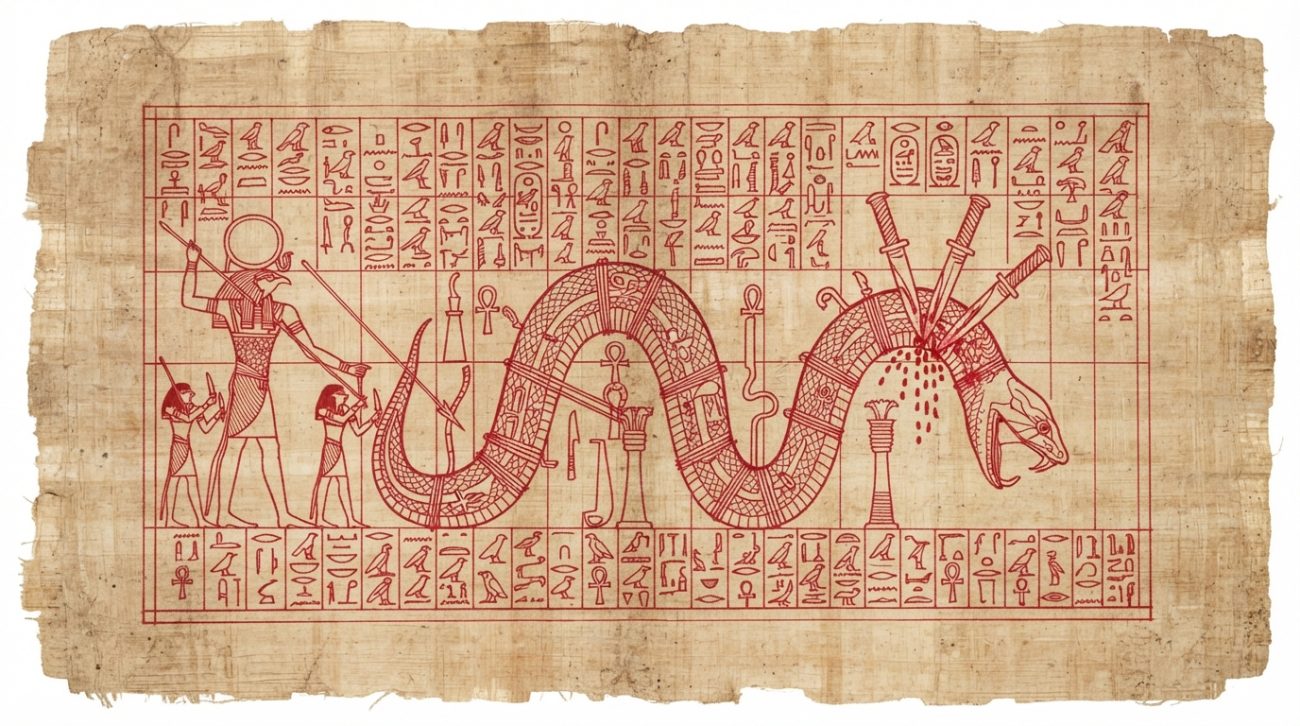
- Excavations at Thutmose III’s mortuary temple in Thebes recovered about 40 burnt papyrus fragments made for a curse on the serpent Apophis.
- Drawings of Apophis survive on 12 fragments and of his allies, the Children of the Rebel, on 14; about 16 are too damaged to sort.
- Assuming one fragment of each design per ceremony, the temple’s priests performed the curse at least 20 times, though not necessarily daily.
- Red grid lines show the drawings were mass-produced in rows of squares and cut apart, like a later intact sheet at the Metropolitan Museum of Art.
The curse was meant to leave nothing behind. Egyptian priests drew the serpent Apophis in red ink on fresh papyrus, stabbed the drawing and burned it, so that the great enemy of the sun god went up in smoke with it. Charred fragments from a temple rubbish dump at Thebes show the Apophis curse being performed there repeatedly, about a thousand years before its best-known manual was copied. How often, and by whom beyond the temple’s own priests, the fragments can only partly say.
The temple belonged to the pharaoh Thutmose III, on the west bank at Thebes, where an Egyptian and Spanish project has been digging since 2008. Fredrik Hagen of the University of Copenhagen, with Carina Kühne-Wespi of the University of Heidelberg and Myriam Seco Álvarez of the University of Seville, describe the finds in a peer-reviewed paper in Zeitschrift für Ägyptische Sprache und Altertumskunde. The fragments turned up between 2014 and 2025 just outside the north enclosure wall, in the temple’s garbage dump, a strip about 75 meters long and 10 to 20 meters wide. Pottery around them tentatively places them from the mid to late 18th Dynasty into the early 19th.
In Egyptian myth, Apophis was the giant serpent who attacked the sun god Re every night on his journey through the underworld. Priests fought back with what Egyptologists call an execration ritual, a curse carried out by destroying an image of the enemy; a 2008 encyclopedia entry by Kerry Muhlestein describes such rites aimed at Egyptians, foreigners and supernatural forces alike. The fullest instructions for cursing Apophis survive in the Bremner-Rhind papyrus, a roll now in the British Museum that a Theban priest acquired around 305 BC. It tells the ritualist to draw Apophis in red ink on a new sheet of papyrus and put the drawing on the fire.

Serpents Drawn in Rows of Squares
The fragments follow those instructions closely. Both designs are drawn on new papyrus, inscribed on one side only, in red ink alone. One design shows a single serpent, head turned downward, cut by three knives, under a caption naming Apophis with two of his epithets, the Roarer and the Terrifying-of-face. The other shows three serpent-like beings with non-serpent heads, labeled the Children of the Rebel, creatures that could stand for Apophis himself or act as beings in their own right.
Thin red lines frame many of the drawings. That framing tells the authors the images were drawn side by side in rows of squares on a larger sheet, then cut apart, so the fragments were mass-produced. Small differences in the drawing and the handwriting mean they came from more than one sheet and more than one scribe. An intact sheet held by the Metropolitan Museum of Art, found at Deir el-Bahri and probably made in the 26th Dynasty, shows the uncut product: five serpent squares, each about 4 by 2 centimeters, carrying the same caption. One side is written in mirror-image hieratic script, the only systematic use of reversed hieratic known.
Cutting the squares out was only the start. The Bremner-Rhind manual runs through spells for spitting on Apophis, trampling him with the left foot, striking him with a spear, binding him, stabbing him with a knife and finally setting him on fire. “The papyrus drawing was often completely destroyed during the ritual, when it was trampled on, spit on, pierced with a knife and ultimately burned,” says Hagen. Several fragments are burnt around the edges, and some carry holes that may come from the stabbing, the authors suggest, because they look unusual for insect damage.
Counting Ceremonies From Burnt Papyrus
Of the about 40 fragments, 12 show Apophis and 14 show the Children of the Rebel, while roughly 16 are too damaged to assign. If each ceremony used one square of each design, the curse was performed at least 20 times. The authors say that is not necessarily enough to show a daily rite in this temple, though it suggests a certain regularity. A ceremony that used several squares of each kind would make the count a weaker guide to frequency. Pulling the other way, many more squares will have burned until nothing recognizable was left.
Burning was the point, which is why physical remains of the ritual are rare. Clay figures used in other curses were often buried intact, and Muhlestein’s entry calls papyrus, wax and other perishable victims largely invisible to archaeology. Hagen suspects another reason too. “The reason physical remains of this ritual have never been found before is probably also that few people have paid much attention to such rather unglamorous rubbish dumps,” he says. Overlooked material has paid off in Egyptology before, as with royal skeletons from Dahshur that sat in a museum basement for a century, and reading what an object was used for from the marks it carries is a familiar move, from these knife holes to chemical residues on ancient Arabian stone points.
Who Spoke the Curse, and Against What
A temple dump implies temple priests, and a later text names which ones. The Book of the Temple, a manual of how a temple should be staffed that survives only in Roman Period manuscripts, assigns the work to two posts. A scribe of the god’s book wrote on papyrus and wax, and the authors think it plausible that such scribes drew the Thutmose III fragments. A scorpion charmer, a priest who also treated snake and scorpion bites, recited the spells while the images burned.
The manual itself claims a wide reach. Its curses target the enemies of the pharaoh, and one passage recommends the ritual against storms, which it blames on Apophis. Another promises a private individual protection from evil and help toward promotion, and a few other sources hint at use in treating illness. Hagen goes further in the press release, saying references in other contexts show “that it was widely used outside temples, and that it was a common feature of Egyptian culture more broadly.” The paper is more guarded: how far people outside temples could reach and perform the ritual, it says, is more difficult to pin down.
The release also says the fragments are around 3,400 years old and push the ritual’s dating back by 1,000 years, measured against the Bremner-Rhind copy. The paper frames them as the earliest direct evidence of the rites found so far. A Ramesside royal statue and stela already preserved passages from the same ritual, and when it was first composed is contested, with one recent analysis allowing an origin as early as the Old Kingdom.
The authors conclude that the Apophis curse was probably not far behind the Opening of the Mouth among Egypt’s best-known rituals. Their full set of fragments awaits final publication, and other papyrus from the same dump has turned out to be the temple’s administrative archive, a record of the daily economy behind its offering cult, found in the same area as the curses.
Reference
Hagen, F., Kühne-Wespi, C., & Álvarez, M. S. (2026). Cursing Apophis: Text and Material Culture of an Egyptian Execration Ritual. Zeitschrift Für Ägyptische Sprache Und Altertumskunde, 153(2), 214–239. https://doi.org/10.1515/zaes-2026-0004
- Study type: Archaeological and philological study of excavated papyrus fragments, compared with surviving ritual texts. Peer reviewed, open access, in Zeitschrift für Ägyptische Sprache und Altertumskunde.
- Sample size: About 40 fragments from the temple dump (12 Apophis, 14 Children of the Rebel, about 16 unassigned), plus one intact later sheet held by the Metropolitan Museum of Art.
- Material examined: Burnt, red-ink papyrus fragments from the garbage dump outside the north enclosure wall of Thutmose III’s mortuary temple, Thebes, read against the Bremner-Rhind papyrus and other texts.
- Dating method: Associated pottery in the dump layer, which the authors describe as a tentative date range.
- Period covered: Mid to late 18th Dynasty to early 19th Dynasty for the temple fragments; the Met sheet probably 26th Dynasty. Fragments recovered 2014–2025.
- Funding / conflicts of interest: Not reported.
- Data availability: Not reported; the full series of fragments is to appear in a final publication of the papyrus material.
- Preregistration: Not applicable.
- Main limitation: The count of at least 20 ceremonies assumes one fragment of each design per ceremony, and evidence for use outside temples is limited. Not author-stated: the priestly roles come from a text known only from much later manuscripts.
FAQ
Who was Apophis in ancient Egypt?
Apophis was the giant serpent of Egyptian myth who attacked the sun god Re each night during his journey through the underworld. Egyptians saw his defeat as necessary for the sun to rise, and priests performed curse rituals against images of him to help Re win.
Why did Egyptians burn the curse drawings instead of keeping them?
Egyptians burned the curse drawings because destroying the image was how the curse worked. The Bremner-Rhind papyrus lists spells for spitting on, trampling, spearing, binding and stabbing Apophis before setting him on fire, and the ritual counted on the papyrus being destroyed.
Did ordinary Egyptians use the Apophis curse, or only priests?
Whether ordinary Egyptians used the Apophis curse is still uncertain. The ritual text promises a private individual protection and help toward promotion, and Hagen has said the ritual was widely used outside temples, but the paper itself calls use outside temples difficult to pin down.
What else was the Apophis ritual supposed to fix?
The Apophis ritual was supposed to fix more than divine enemies. Its text targets the enemies of the pharaoh, recommends it against storms blamed on Apophis, and a few other sources suggest it may have been part of treating illness.


Cite This Page