
What the Study Found
- Across 93 trees in 3 US states, truffle-fruiting soils had lower organic matter and nitrogen but higher iron and magnesium.
- Bacterial communities in fruiting soils diverged sharply from barren ones (PERMANOVA R² = 0.806, p = 0.001).
- The black truffle fungus itself was present in every soil sampled: fruiting vs. barren isn’t explained by its presence.
- Fruiting soils hosted more diverse, more tightly connected microbes and 43 genera found only where truffles grew
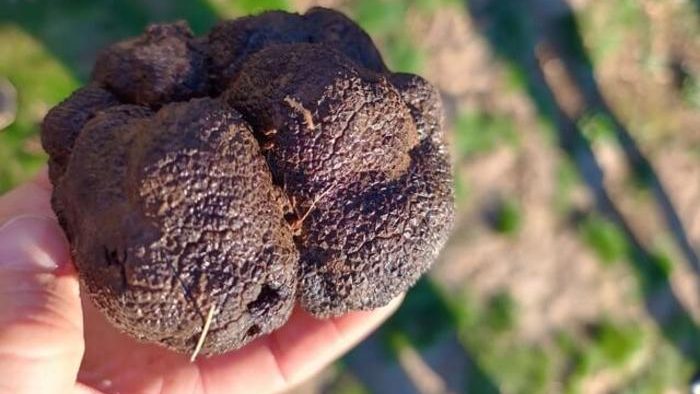
Two oak trees stand a few metres apart in a Kentucky orchard, planted the same year, watered by the same rain, pruned to the same height. One produces black truffles worth over €1,000 per kilogram. The other, nothing. A study out this week, from a team that dug up soil beside 93 such trees across California, Kentucky and North Carolina, points at an answer that is stranger than it looks.
The truffles themselves, it seems, may be re-engineering the soil around their host to encourage their own reproduction. Not just settling into a nice patch of dirt, but reshaping the chemistry and microbial community beneath the tree until conditions tip in their favour.
Anyone who’s walked through a mature truffle orchard has seen the first clue. Around some productive oaks and hazelnuts, a strange bald ring appears in the grass, a vegetation-free zone the French have long called a brûlé. Nothing grows there, or almost nothing. For years, researchers have argued about whether the brûlé is a cause of truffle production, a consequence of it, or just a peculiar side effect of the fungus growing outward. What’s been missing is a clean comparison between fruiting soil and its barren neighbour.

Enter Paul Thomas, an honorary professor at the University of Stirling and founder of Mycorrhizal Systems Ltd, who last year cultivated the first truffle ever recorded on a UK island (the Isle of Bute, if you were wondering). He and his colleagues wanted to know what actually distinguishes a fruiting patch from a barren one, when everything else has been held steady.
A bald patch on the ground
Working with truffle growers and scent-detection dogs across three US states, the team sampled soil beside 93 trees, some producing truffles on the day of the visit, some sporting brûlés without ever bearing fruit, some barren of both. Each productive site was paired with a nearby non-productive one, within 100 kilometres, matched for host species, soil type and management. That paired design, not much used in truffle research until now, lets you begin to strip out the confounders that have muddied earlier work.
The findings, published in Microbiological Research, are striking. “Truffle-producing soils had lower organic matter and nitrogen levels, contained higher levels of iron and magnesium and supported more diverse bacterial and fungal communities,” Thomas explains.
Dig into the numbers and the picture gets even more interesting. Bacterial communities in productive soils clustered so tightly together, and so far apart from communities in barren soils, that the split was near-total by a standard ecology metric. Fungal communities showed the same broad taxa across every site, though productive orchards hosted a richer and more evenly distributed range. Chemoheterotrophic microbes, the ones that recycle organic matter and mobilise nutrients, were noticeably abundant where truffles were fruiting. And network analyses showed that these communities were not just more diverse but more cohesive, more tightly wired together, as if the microbes were talking to one another instead of merely sharing an address.
Presence isn’t enough
Here’s the twist. When the team looked for Tuber melanosporum, the black truffle fungus itself, they found it in every single soil sample, productive or not. The species that makes the truffles was there all along, in barren orchards and thriving ones. Whatever the difference is between a tree that fruits and one that sulks, it isn’t the mere presence of the fungus.
Thomas is careful about how far to push this. The study is observational, and correlation, as any first-year statistics student will remind you, is not causation. Some non-productive trees may simply be young for their category, or waiting on some microbial threshold to tip over. Still, the pattern is consistent enough that Thomas and his co-authors reckon they may be seeing something ecologists call niche construction, where an organism remodels its own environment to suit its needs.
If they’re right, the implications reach a good way beyond the fine-dining trade. The global truffle industry is projected to be worth over $1 billion by 2030, and cultivation is famously unpredictable, with orchards sometimes waiting a decade for a first fruiting and some never producing at all. Clear soil benchmarks, and possibly microbial inoculants drawn from the roughly 43 unique genera the team found only in fruiting sites, could take some of the gamble out of planting a new orchard. More broadly, the results add another wrinkle to our understanding of what is often called the Wood Wide Web, the vast mycorrhizal network binding forests together. “The implications are broader than just truffles,” Thomas says, arguing that the work should enhance our understanding of mycorrhizal ecology in general.
For now, his team is trying to isolate those signature microbes and test whether adding them to a struggling orchard can nudge it towards fruiting. If it works, the underground engineers may soon get a bit of help from above.
- Study type: Observational, paired field study (productive vs. non-productive orchards)
- System: 93 host trees (Quercus and Corylus, 10–13 years old) across California, Kentucky, and North Carolina
- Sample groups: 21 truffle-producing, 15 has-brûlé productive, 18 no-brûlé productive, 20 has-brûlé non-productive, 19 no-brûlé non-productive
- Methods: Soil chemistry (Mehlich 3, DTPA, ICP-OES) + Oxford Nanopore MinION sequencing (~18.4M reads); Kraken2/Bracken taxonomy, FAPROTAX functional annotation, PERMANOVA, SEM, RMT co-occurrence networks
- Key comparators: Fruiting vs. barren soil at paired sites within 100 km, matched for host species, soil type, and management
- Main finding: Fruiting aligns with distinct chemical profile (lower OM/N, higher Fe/Mg) and more diverse, cohesive microbial communities — despite Tuber melanosporum being present in all soils
- Main limitation (author-stated): Observational design cannot establish causation; some non-productive trees may be pre-fruiting rather than permanently barren
- Sample size caveat: n per group ranges 15–21 trees; adequately powered for community-level comparisons, less so for rare-taxon inference
- Funding: Innovate UK (grant 10075683); open-access fees covered by University of Stirling
- Competing interests: Lead author Paul Thomas is founder of Mycorrhizal Systems Ltd, a commercial truffle cultivation company — relevant given the applied implications for inoculant development
- Peer-review status: Peer-reviewed. Published in Microbiological Research (Elsevier), Vol. 311, October 2026
- Preclinical/readiness: Basic ecological research; commercial application (microbial inoculants) not yet tested
Reference
Thomas, P. W., Zahid, M. S., & Slater, A. (2026). Truffle fruiting occurs in chemically and microbially distinct soil niches. Microbiological Research, 311, 128593. https://doi.org/10.1016/j.micres.2026.128593
Frequently Asked Questions
Why does this matter if I’m not a truffle farmer?
The study offers evidence that ectomycorrhizal fungi may actively reshape soil to support their own reproduction, not just passively occupy favorable ground. If that pattern generalizes to other fungi in the mycorrhizal networks connecting forest trees, it changes how ecologists model belowground nutrient cycling, carbon storage, and forest resilience.
Why doesn’t planting the fungus guarantee truffles?
The team detected Tuber melanosporum in every soil they sampled, including in orchards that have never produced a truffle. Fruiting appears to require a broader soil condition (lower organic matter and nitrogen, higher iron and magnesium, and a more diverse, tightly connected microbial community) not just the fungus itself. That’s why inoculated orchards can wait a decade for a first harvest, or never fruit at all.
What would a grower actually do differently based on this?
In the near term, use the chemical signature (organic matter, nitrogen, iron, magnesium, manganese levels) as a site-selection benchmark before planting. Longer term, the 43 microbial genera found only in fruiting soils are candidates for inoculants that could be added to underperforming orchards. But that intervention hasn’t been tested yet.
How confident should we be that the truffle is doing the engineering, rather than just growing where conditions already suited it?
Moderately, but not fully. The paired design controls for major site-level confounders, and the chemical differences the authors flag (organic matter, nitrogen, manganese) are plausibly driven by microbial activity. But this is observational work. Confirming niche construction requires experiments that deliberately alter soil or add signature microbes and test whether fruiting follows.
What’s the conflict of interest here, and does it matter?
Lead author Paul Thomas founded Mycorrhizal Systems Ltd, a commercial truffle cultivation firm that stands to benefit if microbial inoculants prove effective. The paper discloses funding from Innovate UK. The findings themselves are constrained by the data and peer review, but readers should note that the applied direction — commercial inoculants — aligns with the author’s business interests.


Cite This Page