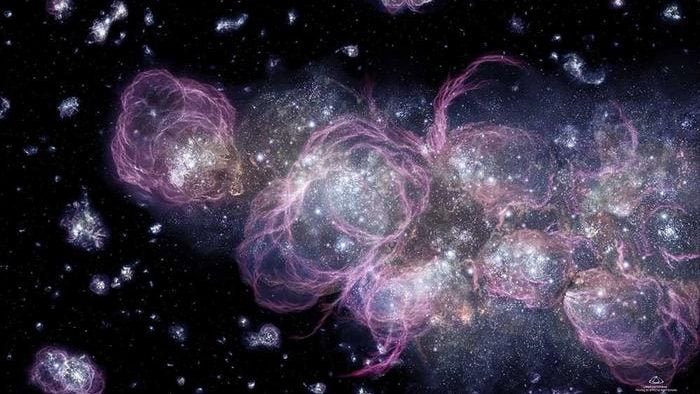
Artist’s conception of early star formation. The first stars may have formed as early as 100 million years after the big bang, when dense clouds of hydrogen and helium collapsed under their own gravitational pull. Once the pressure and temperature were high enough, hydrogen atoms began to fuse together, releasing energy in the form of light. CREDIT NASA, STScI/A. Schaller

Giant Stars Starved of Metals Seem to Run Out of Puff

Ultraviolet spectra of 29 massive O-type stars in six nearby dwarf galaxies show winds weakening as metals thin out, and hint at a sharper drop in the most metal-poor, with consequences for how astronomers read Webb’s earliest galaxies.
Creative surreal art featuring two women with large spherical white headwear touching foreheads.

Scientists Say the Brain Is Two Organs, Not One

Stanford researchers traced two separate progenitor cells in mouse embryos, one wiring up the thinking brain and the other the life support system of breathing and heartbeat, explaining why hindbrain neurons have been nearly impossible to grow in a lab.

Redhead man with a comical expression wearing a pink shirt against a blue background.

A Third of Americans Can’t Name the Three Branches of Government

Asked without answer choices, a third of U.S. adults cannot name the executive, legislative, and judicial branches, the 2026 Annenberg Constitution Day Civics Survey finds. Only freedom of speech is named by more than half. Knowledge of constitutional structure runs stronger than knowledge of rights.

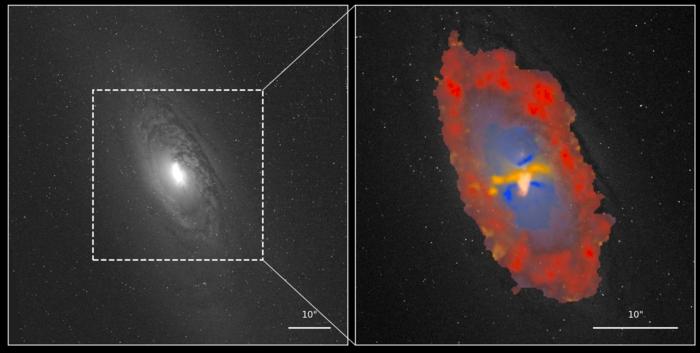
The galaxy NGC1386, shown in grayscale on the left and zoomed in to the central region on the right. The colors represent star formation in red, black-hole radiation in blue, and shocks in yellow. Image courtesy Peixin Zhu. CREDIT Created by Peixin Zhu

Growing Black Holes Line Up Stars, Light and Shockwaves

Nine nearby Seyfert galaxies show a repeating pattern: star forming rings, black hole radiation cones, and shock heated gas positioned at right angles between them, hinting an active black hole might help build stars as well as stop them.

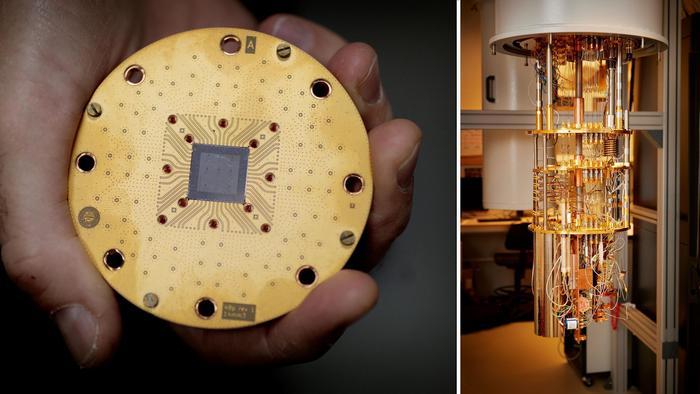
The new method has the potential to accelerate quantum computations by a factor of a thousand, bringing fault-tolerant quantum computers a significant step closer. Photo: Chalmers University of Technology | Malin Arnesson and Anna-Lena Lundquist. CREDIT Chalmers University of Technology | Malin Arnesson and Anna-Lena Lundquist.

One Pulse Now Builds a Quantum Code, Not Thousands

A Chalmers and Tianjin physics team compressed years of incremental quantum-state tuning into one carefully calculated pulse, speeding up a key bottleneck in fault-tolerant quantum computing roughly 1,000 times over, at least in simulation.